
Ministry of Defence

Lest We Forget

The Royal British Legion
| Ministry of Defence |
Lest We Forget |
The Royal British Legion |
|
|
|||||||||||||||||||||||||||||||||||||||||||||||||||||||||||||||||||||||||||||||||||||||||||||||||||||||||||||||||||||||||||||||||||||||||||||||||||||||||||||||||||||||||||||||||||||||||||||||||||||||||||||||||||||||||||||||||||||||||||||||||||||||||||||||||||||||||||||||||||||||||||||||||||||||||||||||||||||||||||||||||||||||
|
|
|
|
Photographs
Copyright © John Tanner 2008 |
||
| BARLOW |
Patrick Basil |
|
||
BIGNALL |
Frederick Hampton |
|
||
| BIRCH, MM |
E Frank |
 [aka
Frank E Birch] Private 19223 2nd Battalion Bedfordshire Regiment.
Son of Thomas Birch of Wellwick Cottages, Age 25. Born at Great
Missenden. Enlisted at Bedford in November 1914, while living at
Croxley Green. Killed in action 21st September 1918 near Basse Boulogne.
On 20th September the battalion failed in a dawn attack north-east
from the Bellicourt road against outposts of the Hindenburg Line.
The attack was resumed at 3pm on the 21st, however, the planned
two hour barrage failed out for the fire of C/IIO battery. 5^th
Infantry Brigade, I8th Division, took Dog Trench, Mill Lane, Pot
Trench, Duncan Avenue and Duncan Post by 3-.45pm. In addition some
150-200 prisoners were taken. Proceeded to France 26th July 1915.
Awarded
Military Medal in July 1917, while serving as a battalion signaller
in the Battle of Messines. Buried in Unicorn Cemetery Vendhuile;
Plot 3, How A, Grave 5. [aka
Frank E Birch] Private 19223 2nd Battalion Bedfordshire Regiment.
Son of Thomas Birch of Wellwick Cottages, Age 25. Born at Great
Missenden. Enlisted at Bedford in November 1914, while living at
Croxley Green. Killed in action 21st September 1918 near Basse Boulogne.
On 20th September the battalion failed in a dawn attack north-east
from the Bellicourt road against outposts of the Hindenburg Line.
The attack was resumed at 3pm on the 21st, however, the planned
two hour barrage failed out for the fire of C/IIO battery. 5^th
Infantry Brigade, I8th Division, took Dog Trench, Mill Lane, Pot
Trench, Duncan Avenue and Duncan Post by 3-.45pm. In addition some
150-200 prisoners were taken. Proceeded to France 26th July 1915.
Awarded
Military Medal in July 1917, while serving as a battalion signaller
in the Battle of Messines. Buried in Unicorn Cemetery Vendhuile;
Plot 3, How A, Grave 5.
|
||
BIRCH |
William |
|
||
| BISHOP |
Thomas |
|
||
BONHAM |
Arthur T |
“Private Arthur Bonham, an old member of the Boys’ Brigade, has written and interesting letter from the front, from which we have an extract:- 'We have not been in the trenches for about a fortnight no, but up till then we had fours days in and four out. It was a fairly quiet part of the line that we were in, though of course at times it was rather warm, such as rapid firing, and a few shells flying over, but we soon got used to them We used to hear at hone that the Germans couldn’t shoot, but can’t they? I wouldn’t give them half a chance if a I knew it. At present we are billeted at a large village some miles behind the firing line, doing some training, and it is very trying , as the weather is so hot, but I dare say we shall have it still hotter before long. The woods and country back here are looking grand, but as you get nearer the firing line the villages and towns are battered about dreadful, and at some of them there are churches in ruins which at one time must have looked splendid and quite beautiful. We all have the same wish as you, that it was all over and that we could get back home again, but I am afraid that that will not be for some time yet. It is quite amusing trying to make the French people understand different things we want, but in most shops they are picking up English wonderful, and can quite understand, but that is chiefly where troops have been billeted.’”
At 1.55pm on the 27th August 1917 the 1st/4th Battalion moved forward from dug-outs in the canal bank at Reigersberg Camp. They moved up to their assembly positions in the Triangle via Infantry route 4. The assembly trenches were reached at 4pm with very few casualties despite having to pass through a heavy barrage. The battalion dug-in on this position, with its HQ in a blockhouse north-east of Mon du Hibou. At midnight they took over the frontline. After her son's death Mrs Bonham received a letter from an unknown officer saying that he had died painlessly, and that his body had been taken from. the battlefield for burial. The Wendover Magazine of October 1917 included the following: “Arthur Bonham also fell in action with the Territorials a few days later – August 27th. He was one of the original “Terriers”, having joined up on Sept. 7, 1914, and having gone out to France first on 30 March 1915. Badly wounded on August 16, 1916, he was sent to Hospital in Hackney, and then to re-cuperate in Ireland. Early this year he was sent out again to re-join his Battalion.. Second-Leiut. F W Caldwell wrote a most sympathetic letter to his widowed mother to tell her of her great loss, and to her it is a bitter blow, for sympathising friends will recall that she has lost husband, one daughter , and a son within a few years. Arthur, before the war, had been employed by the late Mr R White.” |
||
| BOWDEN |
Archibald |
The Wendover Magazine of November 1917 included the following: “News came through during the month of the deaths of Private Jessie Slade and Gunner Archie Bowden…. Archie Bowden was one of Jessie’s schoolmates at Wendover school, whence his daily walk took him to Scrubwood. He also joined up before being called up, and being fond of horses was drafted to the RFA. At the Baptist Sunday School and at his work for Messers. Rance he had always been quiet and obliging, and the shock to his parents (Mr and Mrs James Bowden) and family when the news came of his death on Sept. 204th was great.” |
||
BOWDEN |
William |
|
||
| BUCKINGHAM |
Benjamin Joseph |
The Wendover Magazine of October 1917 included the following: “Another ‘Ben’, but possibly not so well-known, for he had spent thirty years at sea; and met a sailor’s death by drowning, his vessel being sunk by a Hun pirate. Born at Kimble, he married the daughter of Mr George Wyatt, who shares the home in Nightingale Road, where the widow and little child live. He joined the Mercantile Marine service as a youth, and since the war had twice before been on board vessels sunk by the U boats, to meet his death with a third this September. ‘The sea and him in death….. ‘this now his rest for ever.’” |
||
BURNABY, DSO |
Hugo Beaumont |
Youngest son of the Rev. Sherard Beaumont Burnaby, vicar of Hampstead, and Jane Mary 3'urnaby. Born in Hampstead on. the 5th May 1874. Educated at Uppingham. Engaged in ranching in British Columbia from 1893 to 1899. In 1906 married Evelyn Violet, youngest daughter of the late Major-General C H Smith. One son and two daughters. Ran a game farming business at his home, Rocketer, near Great Missenden. Age 42 Killed in action 8th September 1916 near Delville Wood. On I8th January 1900 enlisted in the 1st Wiltshire Company, 1st Battalion Imperial Yeomanry. Embarked for South Africa on the 1st March 1900. Commissioned as Lieutenant 1st March 1900. Promoted Captain in June of that year and mentioned in despatches. In the London Gazette of 31st October 1902 was awarded the DSO " in recognition of services during operations in. South Africa. " On 26th September 1914 took up appointment as Major in the 15th Battalion Durham Light Infantry at Halton Park. Moved with the battalion to Maidenhead in April I9I5« On 5th July 1915 assumed command of the 1lth Lambeth Battalion of the Queens. Took the battalion to France on the 5th June I9I6. On the 8th September 1916 the battalion was in billets at Meault. He went forward with his four Company Commanders and was killed while reconnoitring the front line trenches. Buried in Danzig Alley Cemetery, Mametz; Plot I, Row D, Grave 51. The Wendover Magazine of October 1916 included the following: “If the worth of a man, apart from any professional honours he may have attained, can be estimated by the general esteem in which he is held, the Lieut-Col H B Burnaby, DSO, stands in no need of any obituary panegyric. On all sides, from every class of the community, the deepest and sincerest sorrow was expressed when the sad new circulated through the village that he had died out in France. On Sept 8th, while he was inspecting his battalion of the East Surrey Regiment, he was struck be a shell, and died almost immediately afterwards. So passed away one of the best and most gallant of men. Hugo Beaumont Burnaby was the youngest some of the Rev S Beaumont Burnaby, Vicar of Hampstead. He was born on May 5th 1874, and so was a little over 42 on the day of his death. After being educated at Uppingham, he went to British Columbia at the age of 19, and was engaged in ranching there until the outbreak of the Boer War. Returning to England, he at once enlisted as a trooper in the Imperial Yeomanry, and was sent out to the Front. A born soldier – the phrase is now a hackneyed one, but it was essentially true of Colonel Burnaby – he quickly made his way. In March 1901, he was given his commission , and three months later he was gazetted Captain. The work he did in the South African War was very distinguished – far more distinguished, the writer has been told, then even the high military honours conferred on him denoted. He was mentioned in despatches, and was decorated with the Distinguished Service Order. He was badly wounded in the war, and we remember how, he laughingly told us that at few days before the outbreak of the present war the last piece of shrapnel came out of his chin while he was shaving. ‘I shall just have time to go and collect some more,’ he said. Returning to England, he set about the founding of the Rocketter Game Farm, starting in the smallest way, and, by dint of great perseverance and industry, building up what was undoubtedly one of the best businesses of its kind in England. He married in 1906 the youngest daughter of Major-General C H Smith, CB. He was a very familiar figure in Wendover. Everybody knew him and everybody liked him, and this universal popularity was not, as it so often is, a mark of a weak character, but a testimony to his fine qualities. He was always courteous, always considerate; he loved a joke, and his laughter was infectious; he had a simplicity and directness which were charming, and he had a joy of life which showed itself, not only in his engaging smile and laughter, but in the very way he walked and carried himself. When the war broke out, he was over forty, and though he sent in his papers, the War Office did not believe at that time that they would require officers of his age. This lack of military employment fretted him, but, anxious to do what he could, he took charge of the guard at the Chiltern Hills Water Works and of the Wendover Company of Special Constabulary. By some natural instinct, he was a leader of men, and he had the art of getting the most out of those under him.. The writer, by no means an impressionable person, knows that he did a lot of things for Colonel Burnaby in the Special Constabulary simply because he seemed so pleased and grateful, and was so ready to praise whatever was done. About six weeks after the war started, when the 21st Division came down to Halton, tired of appealing to the War Office, he applied direct to the Headquarters at Aylesbury, and was at once given his company in the Durham Light Infantry. At this time he knew practically nothing about drill, and we are writing this article on the table where, with the aid of matches and much laughter, it was explained to him how fours were formed. On the following day he was to begin his new military duties by marching his company up from Aylesbury. But all things military came natural to him. During the training at Halton he was at first stationed under canvass in the lower camp – in that dreadful swamp of mud and water – he seemed the most cheerful person in the whole place. In January 1915 he went to Maidenhead, and we have a letter in front of us in which he declares that he is sick of what he calls Red Tape and office work, and expresses his longing to get out to the Front. In June 1915 he was appointed Colonel of a battalion of the East Surrey Regiment. We saw several of the Durham Light Infantry the day he left. In their gruff North Country way they cursed and swore at the Powers-that-be for taking from them an officer they so dearly loved. We are told that some of the men cried when he left, so great an impression had his fine and engaging qualities made on them. The last time we saw him was at Marylebone Station. He was still wearing his old Captain’s uniform., though he had already been appointed to his Lieutenant-Colonelcy. We spoke and shook hands in the hurry of getting out of and getting into a train, and that unknowingly was our last glimpse of the tall, graceful, splendidly-built figure of Lieutenant-Colonel Hugo Burnaby. He leaves behind him a widow, a son to carry on the name of Burnaby and the traditions associated with that name, and two daughters. It would be futile to express here any of the ordinary sentiments of regret and sorrow, but if universal sympathy can assuage the bitterness of such a loss, then perhaps the knowledge of how much he is missed for miles round his home at Wendover Dene may be of some comfort to his widow." |
||
| CAUDRY |
Charles Henry |
On 1st July the battalion was in support to the 1st Battalion East Lancashire Regiment. At 7.30am. the latter attacked from the British front line on Redan Ridge north-west of Beaumont Hamel. They came under heavy machine-gun fire as soon as they left their trenches.. Ten minutes later the 1st Hampshires left their trenches. A, B and half of C Company formed the first wave. The remainder of C Company were to assault a German trench on the left flank and D Company were in reserve* As soon as they left the trenches heavy machine-gun fire was bought on them from all directions. Casualties totalled 26 officers, all of those engaged, and 559 other ranks. |
||
CARTER |
Gordon Geoffrey |
On 3Ist May the Regiment was encamped in a branch gully off the Wadi Guzze, near El Shellal. Four bombs were dropped on 1st Troop,, A Squadron. Fourteen men, thirteen from A Squadron and one from. C, were wounded, one dying within a few minutes. The remaining men were evacuated to to. 24 General Hospital at Kantara. Eighteen horses were killed by the bombs and the same number wounded.. One further man died of wounds in, hospital that evening. Buried in Kantara War Memorial Cemetery; Row C, Grave 73. The following letters were published in the Bucks Herald on 7th June 1917: 24
Stationary Hospital Dear Mr and Mrs Carter I feel I must write a line of sympathy to the nearest and dearest of Corpl.. Gordon Carter (935) Bucks Yeo. who died last night at 11.20pm. He had been badly wounded in the back by part of a bomb dropped from a Taube, but of course everything had been done for him that could be. Yesterday when looking for two men reported as dangerously ill I came across him in the next tent and after sitting with him a little time, I told him there were others I had to see who were very bad in the next tent. I did not want to leave him, but as I had been sent for, I told him I had to go but would come back again,. Although he was obviously in pain and wanted me to stay, he said "Yes go and comfort them, do not worry about me." He was a brave lad and when I came back I sat with him. He said it was such a long time for me to sit with him. He was so nice, and spoke so well of another chaplain further up the line, I think, who used to come and see him regularly. Weil don't worry about him. He only wanted sleep and rest. I prayed that he might have this; and then after his medicine, I told him, “Now you must go to sleep.” He smiled and said, “Oh no, Sir, not before about two hours,” and then he settled himself quietly and quite soon I left him resting, breathing quickly but asleep. But in a little over two hours – it was then just 9 o'clock (lights out) – he fell asleep and entered into that other rest which always remains for the children of God. May he rest in peace and may God comfort your hearts. I hope I have not written too much to distress you. But he was so nice a fellow that I loved him, and wished I could have done more for him. Yours sincerely A J Bennet CF PS
It will be such a long time before get this 8th June 1 917 Dear Mrs Carter - Before this reaches you, you will have heard the sad new/s of the death of your son, No. 935 SS Corpl. G Carter and I am writing to express my sympathy for you all in your great loss. Your son was wounded on May 3Ist by a piece of a bomb dropped from an enemy aeroplane, and was badly wounded in the back. It happened in camp, so luckily, the doctors were able to attend to the wounded in a very few minutes after the explosion. Your son was removed to hospital at once, and he was taken down the line as far as the hospital on the canal, where I understand he went under a serious operation. At present we have not heard the full particulars, except from the hospital staff, saying your son died in the hospital after a serious operation. We hope for more details. He died on the evening of June 4th. Your boy's death is a great loss to us all, as he was such a fine man, and, soldier, and above all things, always a gentleman. I feel his death myself very much; as I was in the same troop in England and on the Peninsula, and when I received my commission I was given the Troop which your son was in, and has been in ever since. He was always happy, bright and cheerful, and was most popular with all ranks. His loss is a great blow to us all. A few days before he was wounded he told me there was a chance that his brother was corning out on a boat which was sunk. I hope for your sakes that this has been found to be incorrect, as you have enough to bear with the loss of one son. I will try to find out further particulars, and will then write to you again. With deepest sympathy I am, yours sincerely Fred
Archer 2nd Lieut. June 8th Dear Mr and Mrs Carter - It is with great regret (I am writing on behalf of the 'Wendover boys) we hear of dear Gordon's death, caused by a bomb. No words of mine can express our heartfelt, sympathy in your sad bereavement, for ''Gordon was held in high esteem by all ranks. Not only was he a first-class sportsman, but a soldier who aid his duty as such-as only a Bucks man can. The sad fatality occurred on the morning of: May 3Ist. An aeroplane came over our camp and dropped four bombss all of which fell on the 1st Troop of A Squad doing serious damage to horses and men, the same wounding Gordon. I arrived on the scene about half-an-hour afterwards as we were some distance from A Squad. By that time Gordon was dressed and gone so could not see him. Only a week before he came over to B Squad to tell me about 'Tom. Little did any of us think that this sad occurrence would rob us of one of the best pals a man could wish for, and all of us feel we have lost a brother, I need not dwell on this sad subject any longer, as we all know how you must feel, only we thought it our duty to offer you our deepest sympathy, hoping it will comfort you to know he did his duty and died a hero. I
am yours sincerely A photograph of Gordon Carter’s grave was sent to his mother by Private Albert Bishop 1st/7th Essex Regt., of Pound Street. June 8th |
||
| CARTER |
Thomas |
|
||
DEERING |
Bertram |
The Wendover Magazine of August 1915 included the following: “Bert Deering, an old CLB boy, who joined the Royal Fusiliers, has been fighting with his Regiment on the Gallipoli Peninsula. In a card we have received he announces that hew has been badly wounded while charging the Turks, and is in hospital in Malta. He says he is getting on well and hopes to be sent home on the next hospital ship.” |
||
| DEERING |
Walter George |
On the 6th May 1916 the battalion was holding the La Targette sector below Vimy Ridge. The day began with the Stokes mortar being registered on the German line. Lt. Brown was killed by a sniper. At 7.57pm the enemy sprang a mine between the old and new craters at the top of Birkin Trench. The battalion put a party into the valley between the craters and prevented enfilade fire being brought on the position. Two men were buried by the mine explosion. The near lip of the crater was consolidated and a sap was dug to connect it with that blown on the 3rd. One man was killed and one wounded in this operation. At 8.13pm a British mine was blown to the north east of the top of Grange Trench. The explosion formed a crescent shaped crater measuring 45 by 80 feet and 60 feet deep. A Lewis gun was then moved up and enfiladed an enemy working party. A further sap was dug from Grange Trench to the crater's lip. A third sap was dug to the south with a 'Y-fork in it and incorporating loop-hole plates. Other casualties one NCO and one man killed, three wounded. Buried in Ecoivres Military Cemetery, Mont St. Eloi; Plot 1, Row J, Grave 20 The Wendover Magazine of July 1916 included the following: “We give below two copies of letters received by the parents of Will Fantham and George Deering, whose deaths on May 8 we chronicled in our last issue. It is not generally known that George had previously been wounded in the head whilst with the Oxford and Bucks, and on returning had been transferred to the Wiltshires. 1st
Wilts Regt. DEAR MRS DEERING Just a few lines to tell you how very sorry I am that your son has been killed. He was in my platoon, and I am extremely sorry to lose him. He died as bravely as anyone could, when we were taking a German mine crater, being shot by a German machine gun, and his death was instantaneous. He has been buried in a cemetery at Mont St Eloi, and of course there is a cross on his grave with his name and Regiment. Please accept my deepest sympathy. Yours
sincerely |
||
DELL |
Cecil Clark |
On the I9th July the battalion was holding the front line from Bond Street to Picantin Avenue, opposite the German, salient known as the Sugar Loaf. The British bombardment started at11am. By 5.30pm nearly 100 men had been killed or wounded, out of rifle strength of 20 officers and 622 other ranks. At 5.40pm the remaining 120 men of A and D Companies filed out into no-mans land by way of Rhondda Sap. They formed up and lay down in four waves under German machine-gun fire. When, at 6pm, they rose up to assault the German line they were mowed down by machine-gun fire. C Company, carrying engineer stores for consolidation, attempted to cross no-mans land but were also cut down at 6.10pm. Orders for the renewal of the attack were cancelled and B Company, with 80 survivors from the other companies, took over the front, line. Casualties were as follows; four officers killed, seven wounded and two missing; sixty-two other ranks killed, one hundred and eighty wounded and sixty-five missing. Commemorated on tne Loos Memorial; Panels 63-85. The Wendover Magazine of September 1916 included the following: The many friends whom Mr and Mrs Dell, of Wellwick, have in this part of the County will deeply sympathize with them in their anxiety respecting the fate of their eldest son Cecil, Lance-Corporal in the 0. and B. Since he left the trenches on July 19 with his battalion to attack the enemy not a scrap of reliable evidence can be obtained respecting him, but there is a faint chance that he may be a prisoner in Belgium, for it is said he was one of the few to get through the wire and reach the German lines. George Wells has made enquiries, but can only say that he heard he was wounded. Will Elliott (now wounded and in England) wrote to :Mrs Dell, and said he was close to Cecil when they climbed the parapet to advance. Cecil shouted "What oh. Will. How did you like the rum?" the reason being, as Will quaintly adds, "as we had none." Will saw him no more, as he was wounded himself in the stomach arid thigh at the German "wire", and, after dressing his wounds in a shell hole, took about two hours to crawl 300 yards to safety, when he was placed in a shell-proof dug-out. Enquiries have been made in all directions respecting Cecil, and it is said that he and Lance-Corporal Stevens were seen to "bomb" their way to the German trenches. Another story says two were taken prisoners. If so these may be the two. Cecil's Commanding Officer wrote as follows to Mrs Dell:- August 15 1916 Madam It is with the greatest respect that I send you my deep sympathy in your anxiety about your son. As you know, I thought the world of your boy (Will) now in the First Battalion, and during the four months I have been with this Battalion I soon found out the worth of your other son (Cecil) too. I would give anything to be able to send you news of him. But since July 19 there is none. As soon as any news arrives I will write to you at once, but I am bound to tell you that the chances are out faint that we shall get any more news. Yours sincerely George W Bowyer |
||
| DORRELL |
Arthur James |
At 1am on the 24th of August, zero hour, the barrage opened and the battalion moved forward. They halted on the road in W 29 a arid c, east of Albert, for 20 minutes. The barrage then lifted and moved forward at 100 yards every four minutes, halting on the line X 25 b 7 6 to X 19 b 5 7 for 10 minutes, and then moving on to the objective; La Boiselle village. The German barrage replied at 1.06am, with the majority of shells falling over. At 5.15am a message, timed 4.30am was received from the commander of B Company to say that he was on the objective and in touch with the other companies. D Company reported that they were on the first objective in support of the other companies, who had over-shot the objective. C Company had reached the objective but then been held up on the craters in X20 a 7 3. At 10am a message was received from the commander of A Company, timed 5.30am, saying that he was on position at X 20 a 5 5 but also reported Germans in the craters. Touch was now made with the Royal Welsh Fusiliers on the left. Considerable machine gun fire was reported to be coming from north of La Boiselle and the craters. There was also some firing up Avoca Valley . At 5pm platoons from A and C Companies attacked the La Boiselle craters under cover of a Stokes mortar bombardment. The objective was consolidated by 9pm and 200 prisoners had been taken. Later a patrol from C Company established a post at X 20 b 9 I. At 3am on the 25th they were relieved by the 8th Battalion East Surrey Regiment and went to Square Trench in map square E 7. The battalion remained here until 8prn on the 26th v/hen they moved up to clear Trones .Wood. The battalion’s casualties throughout August were 79 killed, 225 wounded, 9 died of wounds, 10 missing 8 wounded and missing. Buried in Daours Communal Cemetery Extension; Plot 3, Row F, Grave 45. |
||
DRAKE |
Alfred |
After his death Drake's commanding officer wrote to his parents. An extract from the letter was published in the Bucks Herald on 2nd February 1918: I always regarded him more as a friend than an NCO, and I nave never met a man more to be relied on. He was buried in a little cemetery quite near us, the service being carried out by the Assistant Chaplain. I will get a cross made as soon as possible. |
||
| EDMONDS |
George |
The battalion relieved the 2nd Battalion South Wales Borderers in the front line at 3.30am on the 8th. W and X Companies were in the front line, the latter astride the Ypres-Staden railway, in the old German trenches, Bear and Leopard. Y and Z Companies were in support, with' battalion HQ in Spring Farm. (U 22 c 1 1) Patrols were sent out to the Broembeek. At 5.30 in the evening battalion HO moved to a Blockhouse in Bear Trench, at U I7 c 8 1, Z Company moved up from Martins Mill to shell holes behind X Company in Leopard Trench. Tapes were laid out in front of the battalion. At 2.30am on the 9th they formed up on the tapes; Wand X Companies forming the first wave, and Y and Z the second. One hour later the Newfoundland Regiment formed up 150 yards in the rear. It had been raining continuously for 24 hours. The barrage began at 5.20arn and advanced at 100 yards every six minutes. The Broembeek was crossed and the first wave gained its objectives, while maintaining touch with the Coldstream. Guards on the left and the 2nd Battalion Lancashire Fusiliers on the right. At 7am battalion HO moved forward to Namur Crossing (U 18 b 2 9). The barrage halted for one hour and then moved on at 100 yards every eight minutes. The second objective was taken with the 1st Guards Brigade on the left and the Royal Fusiliers on the right. Then the Newfoundland Regiment moved through and took the third objective. The battalion had captured 6 officers and 200 other ranks, with two machine-guns. They had lost 2 officers a line-guns. They had lost 2 officers and twenty other ranks killed, five officers and one hundred and seven other ranks wounded and forty other ranks wounded. Commemorated on the Tyne Cot Memorial; Panels 75 to 77 The Wendover Magazine of October 1917 included the following: Though the official news has not come through, there is little doubt but that poor Geo. Edmonds has paid the great sacrifice, for some of his personal belongings have been returned to Mrs Edmonds. His bother Alf is back in England – severe shell-shock. |
||
FAMTHAM |
Harry |
On the 9th August the company continued work on a gun spur at Noordhofswijk in map square H 6 b. On the 10th work began on extension of the Great Midland line from C 25 a 4 7. Work continued on this until the l6th. On this day they were shelled suffering one milled and sixteen wounded. Two of the wounded men died the next day. Buried in Boulogne Eastern Cemetery; Plot 7, Row I, Grave 22. Commemorated on the family grave in Wendover Churchyard. The Wendover Magazine of October 1917 included the following: Poor Harry received severe injuries whilst with a working party of the Royal Engineers in France, and lingered for some days in the 134th General Hospital, Boulogne, before expiring. His wife had several very kind letters from the Matron, but there was little hope of his recovery, though his death was painless. He was 38 years old, and leaves a young wife and two little children. He joined the army in October last year, and was at first attached to the Suffolk Regiment. He was a well known “Oddfellow”, and in civil life had worked for a considerable time as a farrier for Mr Tom Carter, and more recently at Mr J S Holland’s Brewery.
|
||
| FANTHAM |
William, George |
Commemorated on the Thiepval Memorial; Pier and Face 2C and 3A. Commemorated on the family grave in Wendover churchyard The Wendover Magazine of July 1916 included the following: “We give below copies of two letters received by the parents of Will Fantham and George Deering, whose deaths on May 8 we chronicled in our last issue........ France, 15th May 1916 DEAR MR AND MRS FANTHAM, I take the privilege of witing these few lines to you over your son, William Fantham (No. 2162). No doubt you have been informed before now that he was killed in action on the night of May 8 whilst performing one of the most dangerous duties that falls to our lot, that is, of mining fatigue. He vwas at work down a sap with other comrades when the Germans blew it in on them, burying him and another. I can assure you that all was done to get them out, but it was impossible to save them. What makes it seem harder is that they would have been out of it in about half an hour. He is a sad los to us, being very popular with all on account of his cheerful disposition and his devotion to duty. No matter how hard or dangerous the work, he was always game to the last. I was very sorry to lose him myself, as living with him at 71, Malvern Road, Luton, during his first few months of training it makes me feel a good deal, I can tell you. No doubt Mr Fantham and son will remember me as Corporal on their visit to Luton. I can assure you we have lost one of the best. You have my greatest sympathy in your sad bereavement.
From a comrade France, 16th May 1916 DEAR MRS FANTHAM I regret to write the followingt lines, and I am sorry to let you know that William was killed on the 8th instant. He was one of the best lads in the platoon, and he always seemed bright and jolly up to his last end. Ireceived a small parcel for William, which I divided up between his comrades. Will you please accept from his comrades sincere thanks, and our expressions of sympathy in your sad and sudden bereavement.
|
||
HARDING |
Edward Thomas |
In November 1915 he wrote to his sister: “Q”
Company Dear Sister Cissy I now take the greatest pleasure in answering your most welcome letter which I received quite safe and I was very pleased to hear that you was all enjoying the best of health, as I am quite well myself at present, and I was very pleased to hear that Sam had enlisted in the army , as I thought I was going to he the only one , but after there is three of us serving out of five not such a bad average after all. Dear Ciss I am receiving the paper regularly every week and I saw a list of men serving there is a lot of names on their which seem familiar but I can’t call them to mind not much news must close now wishing you and all at home a merry Christmas and a happy new year from your loving brother. E Harding Pte. Notification was received in June 1916, from Lt. D Murphy, Commanding Depot 1st Oxf & Bucks Lt Inf, that he had been captured at Kut. In December 1917 reports received from the following: Q?M Sgt J W Burbage, Pte. J Willis, L/Cpl V Carter, Pte H Paice and L/Cpl W Swift, indicated that he had died in May or June 1916. Two other reports, also received via the Red Cross, related to Pte. W T Harding, who died at Angora in March 1917. Final confirmation of his death as stated above was received from the Infantry Record Office at Warwick in May 1919. In August 1918 the War Office forwarded the sum of £30 16s 7d in final settlement of his estate, so it seems that death was officially presumed at an earlier date.
Photograph Courtesy & Copyright © Graham Pare 2009 |
||
| HARDING |
Samuel 'Sam' |
It has not been possible to identify the position occupied by the battery on 28th-29th November 1917. However, on I7th December the battery, already in the line, came under the command of 3rd Brigade RGA. The brigade had its headquarters at B 2if b 2 8, east of the Yser Canal near Hulls Farm. The front line had now stabilised on the Passchendaele Ridge. It seems likely therefore that the battery position was to the south or south-east of Pilckem. Other battery records show that Heavy and Siege batteries were engaged in barraging the German held portions of Passchendaele Ridge and on counter-battery work on 28th-29th November. Buried in Canada Farm Cemetery, Elverdinghe; Plot 3, Row F, Grave 34. The Wendover Magazine of January 1918 included the following: Sam and his pal Sam North had both been home on leave recently, so it came as a great shock to hear that he had died of wounds on November 29th so soon after returning to his RGA unit in France. His father and family have our deepest sympathy, for Ted is still prisoner of war in Asia Minor and Sidney was killed in the Spring. His wife died whilst the family was young, and his daughter Annie has faithfully fulfilled her task of bringing up the family; and to her also we tender our deepest sympathy. Sam was 30 years old and the picture of strength and energy. The youngest son Ewart is still in France, and may God spare him is our prayer.
Sam Harding, front, left, seated.
Photograph Courtesy & Copyright © Graham Pare 2009 |
||
HARDING |
Sidney 'Sid' |
On the 8th March the battalion moved into the Clery south sector to relieve the 2nd Battalion Royal Welsh Fusiliers. The relief was completed at 10.50pm. It was reported that the trenches were continuous and good. The enemy wire was thick,, while the battalion's was moderate. Throughout the 9th there was much enemy trench mortaring, but no German patrols were encountered. On the 10th A Company HO was hit by a trench mortar shell; one other rank was killed, and three officer's servants and a gas sentry were wounded. During the night there was gas shelling on the roads and communication trenches. On the 1lth a German aerial dart killed a man of D Company in a sap head, otherwise this was a quiet day. Buried in Hem. Farm Military Cemetery Hem-Monacu; P15t I, Row H, Grave 13. The following letters were received by the family after his death: A
Coy Dear Mr Harding It is with the deepest regret that I have to inform you that your son Private S Harding was killed in action on Sunday March 12th. As you are perhaps aware he acted as my personal orderly & has done so for the last five months. He has always been a hard and conscientious worker, faithful & devoted to duty and he is not only a great loss to the Company & Battalion, but a personal loss to myself and the other officers of A Coy. It may be a slight comfort to know that he suffered no great pain, being unconscious from the beginning. All the officers join with me in offering you all our deepest sympathy. I am sure Cpl Whitworth will be writing to you himself. Yours sincerely Stanley A Sharpe 2nd Lt A Coy PS If there are any further particulars that you would care to know please let me know. I shall only be too glad to do anything can. 231
Coy RE Dear Mr Harding By now you will have heard the sad news of the death of your son, but I must just write you a few lines to assure you of my sincere sympathy. I have only just obtained your address so could not write before. It was on the I3th that I was called in to take the Burial Service, & his body lies in the small cemetery here, the spot being marked by a cross. At such a time you will of course feel the lost very much but may one not find consolation in what the Saviour has taught us & look for a happy meeting beyond the grave. May God bless and comfort. Yrs sincerely Alex F Bellman (Chaplain) PS This letter refers to 25220 Pte S Harding I2th SWB The official notification of his death states, unlike the Commonwealth War Graves Commission record, states that he died of wounds. When this information is taken with that provided by Lt Sharpe it indicates that Pte Harding was probably one of the three Officers' servants wounded by the shell which fell on A Company HQ on 10th March. |
||
| HICKS |
Richard T |
Proceeded to France 17th August 1915. The battalion spent the 26th September 1916 in cellars and dugouts in the southern portion of Thiepval. At 2am on the 27th, the Commanding Officer decided to attack the un-captured portion of the village. C and D Companies were to attack in two waves. A and B Companies were shelled while in the old German dugouts. Zero hour was set for 5.30am, but due to the heavy darkness difficulty was met in forming up. Shortly after 5.45am C Company attacked, but D did not put their attack in until 6.50. Despite the broken nature of the ground the line was carried to the north of the village. Thirty-six German prisoners were taken, and it was estimated that 100 were Killed. The battalion lost two officers wounded and 110 other ranks killed and wounded. The next day they took part in the attack on Schwaben Redoubt, leading with A and B Companies. A Company failed to take Market Trench, being caught by a machine-gun in R 19 c. For this action 2nd Lieutenant Adlarn was recommended for, and received the VC. In his report the Commanding Officer said that the shortage of stretcher bearers made it very difficult to remove all the wounded. Hicks' name does not, curiously, appear in the battalion casualty list for this period; either for the attack on Thiepval or the abortive attack on the Schwaben Redoubt. Buried in Contay Cemetery; Plot 2, Row D, Grave 15 The Wendover Magazine of November 1916, included the following: It is a melancholy coincidence that we have regretfully to announce in this issue the deaths of two of our brave lads who had spent so much of their lives in the woods around Halton and Wendover. The sympathies of everyone have gone out to Mr and Mrs Hicks of Peacock Lodge, who received notice on October 7 that their second son, Richard, had died of wounds on 28th of September. “Dick” was only 18 years of age, and was serving with the Bedfords. He was a born scout, as one would expect from his woodland training, and last summer, with some companions, performed a daring bit of scouting which won the high commendation of his Captain. We have not yet heard how he received his fatal wounds, but we feel sure he was in the fore-front of the battle if he could get there. His elder brother, Jack, is still in France with the Oxford and Bucks, and has been wounded we understand. |
||
HORWOOD |
Richard |
|
||
| HUDSON |
Arthur Hensley |
On 30 July the battalion moved up to Canal Rest Camp at Ouderdom, arriving at l1am. At 9pm they marched up to Zillebeke. At 1.55am on 31 July the head of the battalion was reported as being in the assembly area I 17 d and I 23 a and c. Forty-five minutes before zero-hour, scheduled for 3.50am, the battalion reported itself a s being in the assembly area.. By 5am, the leading battalions reported that the Blue Line Had been taken. Two hours after zero officers patrols were sent out under 2?Lts. M R Hooper and G H Tiga to make contact witht eh 17th Battalion Manchester Regiment. At 6.50am there was an unofficial report that the Black Line had been taken. The battalion moved off from the assembly area in artillery formation at 7.15am. They were passing through Sanctuary Wood, in I 13 c, at 8.30am, when they came under machine-gun and artillery fire. The Manchester’s trenches appeared ungarrisoned and no friendly troops were encountered. At 8.45am the Battalion deployed in extended order under machine-gun firefrom the menin Road and Glencorse Wood, having reached Jackdaw Reserve Trench. The advance was then continued and the line of the road taken. The attack on the Black Line was launched at 9am and the trench-mortars and a battalion of the Suffolk Regiment assisted in reducing a strong point at I 14 a 3 25. The line from the cross-roads at I7 d 9 1 through Jargon Switch to Surbiton Villas had been taken and contact made with the 2nd Battalion Lincolnshire Regiment in J 7 d.. The continuation of the attack was held up, at 10.10am, by rifle and machine-gun fire from the Jargon Line. At 10am, when Captain Hudson’s rave marker records his death as taking place, the line J 7 d 9 4 – the cross-roads at J 7 d 9 1 – Jargon Switch – J 13 b 9 6 – cross-roads at J 13 b 9 5 east of Surbiton Villas was consolidated, contact being maintained with the Suffolks. A counter-attack from Glencorse Wood was broken up at 3pm and the remainder of the day was quiet, the battalion HQ being in a tunnel on the Menin Road at J13 b 3 1. Buried in Hooge Crater Cemetery; Plot 2, Row B, Grave 4. Original grave marker now lodged in St Mary’s Parish Church, Wendover. Hudson is not commemorated on the Wendover Memorial |
||
INGRAM |
Percy John |
On the 1 6th September F Battery moved to a new position at I 7 d 6 7, in open ground north east of Delville Wood. The Brigade HQ was at S 17 d 3 1, just south of Longueval. Throughout the 17th they carried out day and night firing on the whole Divisional front. The enemy's artillery was also in action and all the batteries suffered some casualties from the shell fire, on the I8th visibility was poor and no observation was possible, nonetheless they fired a full programme in support of the infantry. Buried in Heilly Station Cemetery, Meri court L'Abbe; Plot 2, How H, Grave 41. The Wendover Magazine of November 1916 included the following: Our other loss is that of Corporal Percy Ingram (aged 31), of the Royal Horse Artillery, and his father Mr W Ingram, of Parish Piece, also has our deepest sympathy. It will be remembered that Mr Ingram spent many years as a colleague of Mr Hicks on the Halton preserves. He also, like his friend Hicks, has another son in the army. Percy Ingram had served six years in the RHA before war broke out, and joined up with the Reserve when war broke out. In his boyhood days he was educated at Wendover School under Mr J G Bushell, and was in civil employment at Putney Garage when called up in 1914. The following letter to Mr Ingram gives a brief account of his death. His wounds were apparently in the abdomen and arm:- 5th October 1916 DEAR MR INGRAM I was standing just outside your son’s gunpiut when it was hit be a shell, and I was the first man to be near him. I was with him all the time until he was taken away to the hospital He did not seem to be in very great pain, and was quite conscious. He did not say he wanted anything to be done. He was a very gallant soldier: I can say nothing better of any man
Percy won his stripes while serving with the RHA in India, and saw and did good work in the North-West Frontier “scraps”. With his battery he had the honour of being first past the present King at the Durbar. With his good friend ”Yorkie” (presumably a Yorkshire sporting gunner) he kept a brace of sporting dogs, and on one occasion got lost in the jungle while hunting the Blue Bull. His father has some interesting mementoes of his activities. Poor “Yorkie” was with him in the gunpit, and his failure to write indicates that he probably shared Percy’s fate. |
||
| JOHNS |
James Norrman |
|
Private T/2C669I 2nd/4th Battalion, Queen’s, Royal West Surrey Regiment. Also served as T4192. Son of Charles and Edith Johns of Nightingale Road. Living, at Guildford. Enlisted at Guildford in 1915. Age 23 Killed in action 27th December 1917 near Jerusalem. On the 21st December the Company at Flanders Post pushed forward 200 yards onto Cheshire Ridge. The remainder of the battalion concentrated between these two points. Two Turkish attacks on the ridge were beaten off, but when the leading Company advanced onto the reverse slope and tried to cross the right shoulder they were held up. After an artillery barrage the 2nd/1Oth Battalion Middlesex Regiment captured Zamby and the Turks retreated along the wall to the White Hill. The Turks tried but failed to recapture the hill during the night. The battalion lost 2 officers killed, 2 died of wounds and 5 wounded. Thirty-two other ranks were killed and sixty-six wounded, of whom six later died. For the next five days attempts were made to improve the position, out were hindered by the Turks holding Ras Arkub as Suffa. The Turkish guns registered Zamby, White Hill and the Wall in the morning. However, although they were driven off in the morning the battalion was forced to withdraw in the afternoon. As the Turks reached the far slopes of Zamby, and the south side of White Hill, they were forced to pull back from the reverse slope of the latter, and down the Wall to Zamby. At 9pm they were relieved by the 1st/7th Battalion Royal Welsh Fusiliers; having lost 3 officers wounded, 33 other ranks killed and 67 wounded. Buried in Jerusalem War Cemetery; Row R, Grave 113.
Photograph of James Johns and Newspaper Article Courtesy & Copyright © Michael Oates 2009 |
|
JOHNSON |
Arthur |
On the 4th May the battalion, relieved two Companies of the 10th Battalion Royal Welsh Fusiliers in the Monchy defences. They remained there until the 10th, when they were relieved by the 7th Battalion Kings Shropshire Light Infantry. On the 9th they suffered a. heavy and, at times, continuous barrage. The shelling continued when they went into the Brown Line on the 10th, and was heavy on the 11th. On that day one Company and four Lewis gun sections under 2n.d Lieutenant Wainwright were sent to Lid Trench, under orders of the 8th Battalion King1s Own Royal Lancaster Regiment. On the 12th a further two platoons were sent to Lid Trench, leaving at 8pm and returning at 4arn on the 13th. Commemorated on his sister's grave in Wendover churchyard. Buried in Feuchy Chapel British Cemetery, Wancourt; Plot I, Row E, Grave II.
|
||
| KENNEDY |
Nigel |
On the 25th the battalion were holding trenches between Beceleare and Polygon Wood. At 5am the Germans began to shell them and firing was heard in the wood in front of their position. At 1pm the CSM and six men went out as a burial party. They lost three of their number to snipers, but captured one officer and nineteen men while armed only with shovels. Some losses were suffered in the trenches from sniping. At 5pm they were ordered to support the 2nd Battalion Bedfordshire Regiment. The attack went forward immediately but was not pressed. Lieutenant Kennedy was posted wounded and missing. Commemorated on the Menin Gate Memorial; Panels 19 to 33. |
||
LANGFORD |
Henry Herbert |
On the 26th of June the battalion were holding the Ferme au Bois left sector; the area of Hun Street, Hun Post, Hill Post, Port Arthur and Lansdown Post. In the afternoon they were relieved by the Ist/Ist Battalion Cambridgeshire Regiment and went into billets in Richebourg L'Avoue. On the 29th a barrage was put down on the enemy front line from 2pm to 5.30pm. The Germans retaliated by firing on Factory Post and killing ten other ranks. As night fell the majority of the battalion formed up in carrying parties for the 12th and 13th Battalions. At 2.50am on the 30th both sides exchanged heavy artillery fire, shortly afterwards the carrying parties followed the two assaulting battalions over the top to the Gerrman front line. They suffered the following casualties: 4 officers wounded; 2 officers missing believed killed; 4 other ranks killed; 80 wounded and 32 missing. Unusually the casualties in the other ranks are given as only approximate. Buried in St Vaast Post Military Cemetery, Richebourg L'Avoue; Plot 3, Row R, Grave I The Wendover Magazine of August 1916 included the following: Henry Herbert Langford was the son of Mr and Mrs Langford, of Boddington House. Those who knew him speak of him asa good man and a good son, Everybody liked him. For some time he was in service at Hampden House, but when the war broke out he at once joined the Army, being attached, to the 11th Battalion of the Royal Sussex Regiment. This was in August 1914. He was then only just eighteen. His training lasted until the present year, when he went across to France on March 1st. He met his death on June n30th, the day before the beginning of the big push, at the age of twenty. Our deepest sympathy goes out to Mr and Mrs Langford in the great loss they have suffered. They will have the consolation of knowing the their son died like a hero, and that in Wendover his name, ennobled by the cause for which he died, will be held in glorious memory. |
||
| MARSHALL |
John |
At 10pm on the 25th September the battalion moved from dug outs in the canal bank at Boesingh.e, where they had been since the 21st. They moved up via Essex Farm, Buffs Road and the Tin Hut to St. Julien. They were shelled by the enemy at 5am on the 26th. However, at 5.45am they were on the start line running from Cluster House to Von Tirpitz Farm and south of Stoppe Farm. The attack met heavy machine gun and sniper fire and was held up in shell holes, short of the German line, with many casualties. D Company were held up before Vale House, C between Vale House and Aviatik Farm, and A and B short of the farm. At 6am Lieutenant Marshall disappeared into the fog at the head of his platoon. Two platoons of D Company also vanished into the mist and were not seen again. Lieutenant Marshall's name was omitted from the War Office list "Officers Died In The Great War". A note to this effect was put in the Regimental history. The omission seems, however, to have lead to his non-inclusion on the Tyne Cot Memorial, until the author's researches revealed this. |
||
NUNN |
Horace John |
The battalion landed at Suvla Bay on the 6th August. They first went into the trenches, at Lala Baba, on the 14th, losing one man killed and one wounded. They were relieved the next day and went into the reserve trenches, where they lost one killed and two wounded on the 16th. On the 17th they relieved the 5th Battalion Dorsetshire Regiment in the front line. The following day they lost four men killed and eleven wounded. On the 19th they were ordered to attack the Turkish line 700 yards away and 1000 yards south of 'W Hill. They went over the top at 4am, advancing almost to the enemy line, where they were held up by machine gun fire. The casualties amongst the officers were two killed, five wounded and three missing. Three other ranks were killed, one hundred and forty-one wounded, eighty-eight missing and two wounded and missing. On the 20th they were relieved to the reserve trenches, and the next day went onto the reverse slope of Lala Baba. On the 22nd they were moved down to a beach further north up the coast. They only remained there for one day, on the 23rd finding themselves in the front line at Sisak Biyu. They were only to spend that day, and the next, here before being relieved by the 6th Battalion Royal Dublin Fusiliers. However, on the 24th they lost one man killed, seven wounded and one missing. Commemorated on the Helles Memorial; Panels 33 to 33. |
||
| PARKINS |
Benjamin |
From the 1st to the 25th of July the battalion came under the command of the Officer commanding 257th Tunnelling, Company, Royal Engineers. A and C Companies were at Nieupoort, and the other two companies at Oost Dunkirk. On the 26th A and C Companies were relieved and marched to Bray Dunes. During the night of the 26th/27th the battalion was reunified in Coxyde. Casualties during this period were one other rank killed and thirty wounded, in addition one officer and 243 other ranks were gassed. From the 27th to the 31st July they were encamped at Bray Dunes, before taking over the right part of the left sub-sector at St. Georges. B and D Companies were in the line with the other two companies in Maison Blanche. On the 4th of August they were relieved to Ribbaillet camp. There on the 14th they suffered a heavy gas attack. Their casualties were one officer and thirty ether ranks gassed; one man died of gas poisoning; three other ranks wounded and one died of wounds. Total casualties for the period of the 5th to the 17th of August were as follows: due to gas; 2 officers and 14 other ranges wounded, y other ranks died of wounds, non-gas injuries; 5 other ranks killed, 14 wounded and 5 died of wounds. Parkins' death was reported as being due to gas poisoning. Buried in Coxyde Military Cemetery; Plot 2, Row G, Grave 15. The Wendover Magazine of October 1917 reported: Chubby, cheerful little Ben is no more. Wes hall miss his cheerful ways. Joining the ASC last year, he was afterwards attached to the Inniskilling Fusiliers, and met his death (wounded and gassed) on August 13. It is not generally known that he came home on leave to be married this year. Though his father’s home is at Scrubwood, he was always to be seen about Wendover, working for some years for Mrs Terry, an, before joining up, for Mr C S Routh at the Manor House. He was 31 years of age. |
||
PARKINS |
Thomas |
On the 8th of Bay the battalion were holding trenches to the east of Fresnoy. At 3.45am a German barrage came down on all parts of the British line, and on battalion headquarters. Due to heavy mist it was not possible to see more than 50 yards. Because of this the SOS signal put up by the front line had to be relayed to Brigade headquarters and the artillery by battalion HO, over the telephone. The front line companies checked the assault of the 5th Bavarian Division and then fell back. Counter attacks were made by B and C Companies, and the 1st Battalion Duke of Cornwall's Light Infantry. The front line was regained but could not be held as the enemy were on the nigh ground on both flanks. D Company were later sent up to form a new front line. The battalion lost 1 officer killed, 7 wounded, 2 wounded and missing and 3 missing; 288 other ranks were reported as killed, wounded or missing. Commemorated on the Arras Memorial; Bay 6. |
||
| PARSONS |
Arthur Gilbert |
Served with the 1st/4th Battalion in France and Belgium until July 1916. He was then wounded by shrapnel in five places during£ the fighting between Pozieres and Ovillers. The battalion relieved the 5th Battalion Kings Shropshire Light Infantry in the front line at 12.30am on the 23rd of August. During the relief the enemy shelled Jargon Switch and the strongpoint in J 14 a 3 2. From 12.30am to 4am the barrage fell on the Menin Road and the Advanced. Dressing Station. At 4.am there was a heavy bombardment of Jargon Trench. At 4.30am the 43rd. Brigade put up their SOS signal. At 4.42am there was an attack on the battalion's right company and the Duke of Cornwall's Light Infantry. The latter were forced back and the battalion withdrew so as to conform. The battalion boundary was now at J 14 a 6 2, with the enemy contesting the line from J 14 a I 0 to J 14 a 5 I. At 7.30am D Company was reinforced by the bombers from A and C Companies. However, at 5am the Germans had begun to bomb down the outpost line from J I4 a 5 I towards the strong point. A defensive flank was held from the right hand post to the strong point. A counter-attack of bombers and snipers then drove the Germans back. At 9am C Company were ordered up from support. At I0am the British barrage was brought down on the former outpost line and at 2.45pm the remainder of C Company was sent to reinforce D. From 6pm until midnight it was quiet. The battalion's casualties were three other ranks killed, two officers and 109 other ranks wounded and thirty other ranks missing.
The Wendover Magazine of October 1917 reported: Arthur Parsons was killed on August 23, according to the War Office notification, but his sorrowing parents can obtain no further particulars. There are many parents in Bucks who are equally anxious for news of the poor Territorial lads. Arthur was 24 years old, and he went out to France in January, 1916, to be badly wounded on the Somme by shrapnel in July. After leaving hospital at Torquay he spent some time in convalescence at Ballyvonare, Ireland, with Arthur Bonham and Will Elliott. He was sent back to France to re-join the Bucks Territorials early this year, there to meet his sad end. In civil life he had worked as cycle fitter for Mr E J Sharp, who spoke wonderfully well I of him , and latterly for Mr H Wood, who held him in great esteem. |
||
PEDEL |
Alfred John |
On the 14th Of February the battalion was in billets in Dikkebusch. The German barrage began at 4.10pm. At 7.30pm two companies, and one machine gun section were sent up to Voormzeele. They were joined at 8.10pm by the other two companies and battalion HQ. Arriving at Voormzeele, they were ordered to launch a counter attack. They left Voormzeele at 11.45pm, arriving at the front line at lam on the 15th. The 3rdBattalion King's Royal Rifle Corps, and one company of the Leinster Regiment were to cooperate in the attack. The battalion moved over the open country from St Eloi and received instructions to take Trenches 21 and 22. Support was to be provided by the machine guns of the Royal Irish Regiment in St. Eloi. B and C Companies formed the first wave and A and D were in support. The battalion deployed at 3.30am, in anticipation of zero hour, which was timed for 4am. The supporting barrage lasted from 3.30am to 3.45am. The initial objectives were taken. The King's Royal Rifle Corps were then ordered to retake trenches 19 and 20, with the battalion in support. This task was also carried out. Battalion HQ, and the line to the right and left came under heavy rifle fire throughout the day. In audition the HQ and support areas were shelled at dusk, notwithstanding this it was reported that the day was quiet. The battalion’s casualties were one officer and twelve other ranks killed; one officer and twenty-eight other ranks wounded. In a letter to his mother an unknown officer told her that Pedel had been buried close to where he fell. Commemorated on the Menin Gate Memorial; Panel 20. |
||
| PEDEL |
Frederick William |
Sergeant 205060 Ist/1st Royal Bucks Hussars (Also served as 773). Son of Frederick John and Emily Pedel of the Railway Hotel, Pound Street. Born in Halton. Age 21. Died of wounds I6th November 1917 near Ramleh. Enlisted in Aylesbury in 1912. On the 14th of November the Regiment moved to Akir. They were shelled en route, losing one officer and five other ranks wounded. On the 15th they received orders to take Naaneh. Two squadrons and one squadron from the Berkshire Yeomanry galloped to the Abu Shushe position, dismounted and brought rifle fire onto it. When the Bucks Hussars' led horses were brought up at a gallop they joined the pursuit of the Turks and, swinging to the left, captured the high ground commanding Abu Shushe. In doing this they lost one officer died of wounds, one man killed and 70 other ranks wounded. After clearing the position they marched to Naaneh and Ramleh and went into bivouacs. Buried in Ramleh War Cemetery; Plot 9, Row P, Grave 40. After his death the following letter, published in the Bucks Herald on 2nd February 1918 was received from his commanding officer: You will have heard from the officer commanding your son's squadron all the details of his death. I write to you as the officer commanding his Regiment to offer you my most sincere sympathy. Sgt Pedel had distinguished himself by his gallant conduct on November 13 in a charge; he was mortally wounded in a dismounted attack on November I5 and died of his wounds on the following day. The loss to the Regiment is a considerable one, but great strength is gathered from such examples. It must he a great consolation to you to know how well your son had done and that he died gallantly leading his troop. The Wendover Magazine of January 1918 reported the following: The new of Fred’s death in action out in Palestine came to us just as we went to press for the December issue. Following the loss of Alfred in France earlier in the war, this is a sad loss for Mr and Mrs F Pedel, and everywhere we have heard sympathy for them expressed. Fred had not long attained his majority, and was a fine specimen of British manhood. Whilst at school, and before proceeding to Colston School, Bristol, he proved himself a fine boy at sports, and was a most powerful and elegant swimmer. His friends of the football and cricket clubs will be stunned to hear of his death. He joined the Bucks Hussars before he was 16 years old and joined up on mobilisation for war, so he had spent more than two years out in the East. |
||
ROGERS |
Thomas |
The First Battle-cruiser Squadron sailed from the Firth of Forth on the 30th of May. The German Fleet was sighted at 2.20pm on the 31st. The German battle-cruisers opened the engagement at 3.45pm when the Lutzow fired her first salvo. The Indefatigable engaged in a ship-to-ship duel with the Von der Tann, and sank at 4.05pm. Shortly afterwards the Lion escaped a similar fate only by flooding her magazines. At 4.26 the Queen Mary was struck by a salvo from the Derfflinger. It is believed that the flash from these shells penetrated her main magazines, causing the ship to explode and sink in under half a minute. Seventeen survivors were picked up from the total complement of more than I COO officers and men. Commemorated on the Portsmouth Naval Memorial; Panel 16. |
||
| ROWLAND |
Oliver |
On the 3rd of November the battalion took, over the right sub-section of the left hand portion of the Lesbeoufs line. The battalion was disposed as follows: B Company in Summer Trench and five strong points in front of it; D Company in Dewdrop Trench; A. Company in Windy Trench and Z Company in John Bull Trench. There was heavy shelling from 4.30pm to 5.15pm. C Company was then moved into Dewdrop Trench on the right of D. During the night of the 4th/5th 30 men from B Company, under 2nd/Lieu tenant Loverseed attempted to prepare the way for a future attack by taking out a German post. This preparatory raid failed with heavy casualties. Zero hour for the main attack was set for 11.10am on the 5th. At 11.15am the enemy were seen to be retiring and C and B Companies moved up to the right of B. All three companies then moved forward and by noon were dug in 100 yards short of the objective. This put them 150 yards in front of Summer Trench. Touch was maintained with the troops on either side, although the attack by 17th Division on Orion Trench failed. Later in the day the battalion constructed saps back to their own former line and out to the German line. Commemorated on the Thiepval Memorial; Pier 4, Face A. Rowland's mother received a letter from an unknown officer after her son's death. The following extract was published in the Bucks Herald on 17th November 1916: I am very sorry to have to inform you that your son died of wounds received in action on 5th November. He died painlessly and everything possible was done for him. He was buried and a cross placed over his grave. Private Rowland was a very good soldier and did his duty well, and his death is felt keenly by all ranks. You have my deepest syrnpathy in your great loss. |
||
SHAW |
Reginald Thomas |
On the 8th of May the battalion moved up from Les Faucons and put out bridges to cross the stream at Richebourg L'Avoue. They then took up the following positions; in the first line of breastworks, C Company on the right and D on the left; in the second line A Company on the right and B on the left. The limit, of the objective had been set as R 2 and V 1. At 3.30am on the 9th rum and tea was distributed to the companies. Zero hour was set for 5.30am and timed to coincide with the opening of the barrage. The first wave consisted of numbers 9, 11, 5 and 16 platoons; followed by numbers 10, 12, 13 and 14. Number 8 platoon had been placed in reserve with the Royal Engineers. A Company then followed them over in support, advancing in columns of sections with 50 yards between the two waves. The first wave was made up of numbers 2 and 3 platoons, the latter under Lieutenant Shaw. Numbers 1 and 4 formed the second wave. B Company moved up at 5.28am and two platoons, numbers 5 and 6, went over in support of D Company. Two machine guns went over in support of the right hand part of the attack. Number 7 platoon remained behind the breast-works to hold the line. The Royal Engineers, arriving at the breastworks with number 8 platoon, advanced in error and suffered heavy casualties. The advance of the 5th Battalion Royal Sussex Regiment overtook that of the battalion's second wave and caused some confusion. C and A Companies reached within 40 yards of the German line out were then held up. The right of the line was enfiladed by machine gun fire and the left suffered from enfilade fire from an angle in the German line. The major part of the attack was held up 150 yards from the German line. At 6.30am they were ordered to withdraw under cover of a new bombardment and the battalion reformed in the Rue du Bois breastwork. Lieutenant Shaw was wounded while leading his platoon in the early stages of the attack. While arrangements were being made to bring him in he was hit again and killed. Commemorated on the Le Touret Memorial; Panels 20 and 21. |
||
| SIMMONS |
Harry |
On the 1st of July the battalion was in support to the 1st Battalion Lancashire fusiliers and the 2nd Battalion Royal Fusiliers in front of Hawthorn Ridge. C and D Companies and battalion HO. were in Cripps Cut, with A and B in Cardiff Street. The battalion's objective was the German second line east of the Beaucourt Road; Q 6 c 7 0 to Q12 b 00 65. The mine under Hawthorn Ridge was to be blown at 7.20a.m, with the 2nd Royal Fusiliers assaulting ten minutes later. As that battalion reached the German frontline the Middlesex were to begin their advance in platoon columns in single file. C and D Companies were to form the first wave, on the right and left respectively, supported by A and B Companies. Some 120 men of the Royal Fusiliers reached the lip of the Hawthorn Ridge mine crater. However, when the Middlesex crossed the parapet at 8ain they found much of the wire uncut and the gaps between it choked with dead and wounded. They immediately came under heavy machine gun fire from the Bergwerk to the north of Beaumont Hamel. No troops reached the German line. The battalion's casualties were as follows; 3 officers killed, 10 wounded, 6 missing believed killed and 5 missing, in the other ranks; 19 killed, 306 wounded, 37 missing believed killed and 138 missing. This was later revised to a total of 32 officers and 517 other ranks killed, wounded or missing out of a total of 32 officers ands 689 other ranks engaged. Buried in Auchonvillers Military Cemetery; Plot 2, How A, Grave II Also commemorated on the family grave in Wendover Churchyard.
Regarding Harry Simmons we have received the following letter from a prominent Wendover resident, which expresses better than we could much that ought to be written about our dead hero – “DEAR SIR, - May I be permitted a small space in your excellent Magazine to convey to Mr and Mrs W Simmonns and family the sincerest sympathy, I amn sure, of all in Wendover in the great bereavement they have suffered in the loss of their only son Harry, who dies like a man for his country. “Those who knew Harry personally as I did cannot possibly speak too highly of him in every way. Honesty, truthfulness, strict adherence to business, politeness – these were some of his outstanding characteristics – and whatever he undertook to do he did well, whether for himself or others. “As a C.L.B. lad he was keen and one of the best. He was always a good lad at home to his parents, and when he left Wendover to improve himself in business experience one was certain he would succeed. Although it is hard to lose a dear one, Mr and Mrs Simmons have the satisfaction of knowing that their son was trusted and loved by all who knew him – that he has done his duty, and that right well. – N.L.” |
||
SIMMONS |
Mark |
On the I8th of March the battalion took over the Forward Zone between Fayet and Gricourt. C Company took the left front and B the right front. Two platoons of A Company were posted in the road near the Needle. Of the counter-attack companies, two platoons of A and the company HQ were at the Willows (M 28 c 1 5) and D Company and battalion HQ were in Enghien. The next two days were spent in improving the position and sending out patrols to check the German line, as it was considered likely that the attack would begin on the 21st. From 4.30am on the 21st the battalion's position was heavily shelled, much use being made of gas shells fired onto the keeps and back areas. At 9am, under a heavy smoke barrage, the German infantry attacked. The forward Zone was penetrated and Enghien Redoubt surrounded. D Company and battalion HQ held out here until 4pm, when they attempted to fight their way out. The survivors of the battalion, probably less than 50 men, joined the 2nd/5th Gloucestershire Regiment. Fourteen officers were missing, four missing believed killed and one missing. Five other ranks had been killed, 32 were wounded, 31 wounded and missing and 494 missing. The survivors of the battalion were formed into a composite battalion with the remainder of the Brigade. On the night of the 22nd the composite battalion guarded the bridge-heads on the Somme at Voyennes and Offoy. During the day the Regiment lost 1 wounded, 1 wounded and missing and five missing. On the 23rd, when the Brigade rested at Languevoisin and Billancourt, the Regiment lost one officer killed and six men wounded. From his place of burial, well to the east of the battalion's position on the 21st, it seems lively that he, in fact, died of wounds in German hands on the 23rd, having been wounded and captured on the 21st. Buried in Premont British Cemetery; Plot 3, Row AA, Grave I. |
||
| SIMMONS |
THOMAS |
On the 13th of August the battalion moved off from bivouacs to the neighbourhood of Usna Redoubt. At 7am they moved on and took over the front line (Skyline Trench). C Company were on the right, D on the left, B in support and A in reserve, with 2 platoons in Ovillers. There was very heavy shelling all day, notably on Skyline and Ration Trenches. By the evening Skyline Trench had been obliterated. Shortly before 10prn two enemy battalions attacked to the front and the left. The centre of the position was penetrated and the survivors of two platoons of C Company cut off in Skyline Trench. A bombing attack was organized from Ration Trench up to Skyline Trench out it was beaten back. On the 14th, owing to the casualties sustained, no further counter-attack was possible and the line of Ration Trench was held as the front line. At 2pm the battalion was relieved by the Bucks Battalion. During these two days the battalion had lost one officer killed, missing and six wounded, 147 other ranks were killed, wounded or missing. Buried in Warloy Baillon Communal Cemetery Extension; Plot 7, Row C, Grave 30 The Wendover Magazine of September 1916 reported: Another name has to be added to the long roll of Wendover men who have laid down their lives for their country, that of Tom Simmons, of York Buildings. His widowed mother bears up bravely under the shock, and universal sympathy is felt for her and her other son and daughters. Tom had been her main support, being the only single son left at home, and many considered that his age (he was 38), and under such circumstances he might, though attested, have had good grounds for an appeal to the Tribunal . His face and figure were well known in this part of Bucks, as he had worked for many years for Mr T J Stevens, moving about with his steam rollers and threshing machines. The news of his death came to his mother from the Military Hospital as follows; SSM
Hospital BEF Dear Mrs Simmons I am very sorry indeed to have to tell you of the death of your son, T Simmons, 5816 1/4th Oxford and Bucks, who died in this hospital this morning early. He was brought in severely wounded in the abdomen and in a very collapsed condition; but although the surgeon and sisters did all they possibly could do for him, he did not improve, and died at 4amthis morning. He will be buried in the village cemetery at Warloy by our Chaplain. 'With deepest sympathy, Yours sincerely T M Whyte, Sister Tom was by nature very quiet and reserved, and had an aversion to having his photograph taken, so we regret we shall be unable to print his portrait with those of our other heroes, unless some mutual friend has one in his or her possession. |
||
SLADE |
Jessie Robert |
On the 19th of September the battalion was about Au Bon Gite at U 26 d 2 8. At 2arn on the 20th they formed up on the following line; U 23 d 7 4 to U 23 d 4 9 to U 26 d 2 8 to C 3 a 8 2 to C 3 a 3 3. A Company were on the left, B in the centre, C on the right and D in reserve. Battalion HQ was at Double Cottages; U 23 d 3 2. At 5.40am oil drums were fired into the enemy trenches and the cemetery at U 24 c 0 0. Heavy machine gun fire was met from Eagle Trench as the attack went in. By 6.30all companies were digging in west of Eagle Trench. At 5pm a barrage fell on the line U 23 d I 4 - U 29 b 2 9. At 6.30pm the British artillery bombarded Eagle Trench and the battalion attacked once again. There was little resistance until they reached U 23 b 8 05, when they were held up and then bombed back. A block was formed in the trench and part of the battalion was then withdrawn to Louis Farm. Posts were held from Eagle Trench east along the edge of the cemetery to a point south of the road to Louis Farm. On the 21st they were relieved by the 12th Battalion King's Royal Rifle Corps and moved to the east of the Steenbeek. A and B Companies went into shelters at U 3 b 8 8, C and D went to Cork House and battalion HQ was established at Candle Avenue. On the 22nd C and D Companies were heavily shelled, losing their two remaining officers wounded. During this four day period the battalion's total casualties were as follows; 3 officers killed and 9 wounded, 40 other ranks killed, 122 wounded and 33 missing believed killed. Buried in Canada Farm Cemetery, Elverdinghe; Plot 3, How C, Grave 24. Also commemorated on the family grave in Wendover churchyard. The Wendover Magazine of November 1917 reported: News came through during the month of the deaths of Jessie Slade and Gunner Archie Bowden, and we can veryn inadequately express the sympathy we all feel for the two families. Mr and Mrs Sladfe some years ago, long before we dreamt of this war, lost one son by sudden illness whilst he was serving in the army and poor Jessie himself had a severe illness two years ago after he joined the “Terriers”. We scarcely thought he would be considered fit to go abroad. He had been retained for some time as a bugle, and in his old CLB days it was part of his daily recreation at Cold Comfort to practice the calls, and thus to qualify as one of the best buglers in the Battalion. He was only 19 years of age, having joined up long before he was of military age, and his death is given as Sept. 22nd. He was a Juvenile Oddfellow. The magazine also reports that mark Simmons, killed in action 23 March 1918, was one of those who carried him out of action. |
||
| SMITH |
John Henry |
|
||
SPITTLES |
Arthur |
 Son of the late
George and Mary Ann Spittles of London Road. Age 20. Invalided from
the army on account of ill health. Died 9th May 1917 in Wendover.
Buried
in Wendover churchyard. Son of the late
George and Mary Ann Spittles of London Road. Age 20. Invalided from
the army on account of ill health. Died 9th May 1917 in Wendover.
Buried
in Wendover churchyard.
|
||
| TAYLOR |
Alfred Frederick |
On the 19th of August the battalion was in camp at Watou. The company commanders reconnoitred the line about St. Julien. In the afternoon of the 20th they relieved the 2nd/6th Gloucestershire Regiment in the support line. After nightfall they moved up to the front line, relieving the 2nd/4th Gloucestershire Regiment. The 21st was spent in making preparations for the attack, planned for dawn on the 22nd. There was considerable artillery activity on both sides and the battalion lost one officer and 4 other ranks killed and 31 other ranks wounded. The battalion's objective was Gunpit No. 36 in C 13 b (Martha House) to the road junction at D 7 c 25 55. This was a front of 750 yards, 900 yards from the British position. They assembled on the tape laid in front of their position without any difficulties. A, D and C Companies formed the assault wave, numbering, from left to right. B Company was in reserve and 3 platoons of the Royal Berkshire Regiment were to act as moppers-up. The battalion advanced under an artillery barrage at 4.45am. A and D Companies, closely followed by two platoons of B, reached their objectives and consolidated. C Company, on the right with one platoon of B, was held up owing to the failure of the rnoppers-up to take Pond Farm. Both flanks were unsupported but it was decided to hold on. At 4pm with the support of two platoons from the 2nd/5th Gloucestershire Regiment, Pond Farm was taken. The battalion's casualties were three officers and 26 other ranks killed, 5 officers and 74other ranks wounded and 44 other ranks missing. Three of the missing men were later reported to be prisoners. Commemorated, on the Tyne Cot Memorial; Panel 97 to 98. |
||
THOMPSON |
George Buckley |
At 12.45am on the 31st of August the battalion moved from its bivouacs in map-square U 13 d. They moved south-east along Stray Reserve to arrive at their assembly positions by 3.30am. C and B Companies formed the first wave. C were in Pelican Avenue, from U 26 b 6 5 to the south-east. B were in the same trench from U 2.6 b 6 5 to the road at U 21 c 25 10. D Company were in support in Stray Reserve in J 26 b. A Company were in reserve between D and the road at U 2C c 75 35. The trench-mortars had been disposed between A and C Companies, with the battalion machine guns in Golliwog Lane . Not much delay was experienced in capturing Station Redoubt when the attack was launched at 5.15am. The Germans had already withdrawn along Railway Reserve and to the south-east. Some casualties were caused by the British barrage falling short. At 6.30am Bullecourt Avenue was reached and the battalion consolidated it as no further progress was possible. The line held was from C 3 a 7 I to the railway at U 27 d. At 7.30am they made contact with the troops on the right flank. The two tanks, which should have supported the attack, had failed to appear. The German counter-barrage began shortly after zero-hour and lasted until 6.45am. It was then largely quiet after 8am, except for a brief barrage between 3 and 4pm. The right flank of the battalion was exposed owing to the failure of the 1st/4th Battalion London Regiment's attack. At 9am A Company were moved up from reserve to Station Redoubt and the machine guns came up to Pelican Avenue. The day was spent in consolidating the position. About 2pm a party of Germans were discovered in Railway Reserve but were cleared by 5.15pm, with 22 prisoners being taken. German snipers and machine gun were active and communications were maintained by runner. The enemy shelled Longatte, Ecoust and Station Redoubt but no serious attack was made. They lost 11 other ranks killed, one officer and 54 other ranks wounded and 5 other ranks missing. Buried in HAc Cemetery; Ecoust-St-Mein ; Plot 2, Row D, Grave 8. |
||
| TOMLIN |
George |
On the 12th of September the battalion was involved in a local operation to capture Junction Post, near Laventie. Two platoons of C Company were detailed, with three from A, to carry out the task. Zero hour was at 5.15am and the wire was successfully crossed; the objective nearly being reached on both flanks. When the flank platoon of A Company became held up Corporal Wilcox went forward and knocked out four machine guns with his section. For his actions here Corporal Wilcox was awarded the Victoria Cross. Most of the men’s rifles and Lewis guns became clogged with mud and, despite Corporal Wilcox’s actions, the attack failed and the right flank withdrew. Two officers had been wounded and one was missing. Seven other ranks were killed, twenty-two wounded, eighteen were missing and one man was reported missing. Buried in Aire Communal Cemetery; Plot 4, Row D, Grave 30. |
||
TREADWAY |
Arthur |
On the 11th of April 1916 the battalion was holding the trenches in front of Brielen. They were disposed in the line from trench D22 to E28 and the support line. The enemy shelled the trenches with guns and mortars throughout the day. The bombing post north east of E28 was cut off from the rest of the trench. Line Germans then made the first of four attacks. It was destroyed by enfilade fire from the end of E28. The second attack was broken up by shrapnel fire. The third attack was launched on E25 and 26. About 40 Germans advanced from C 14 a 4 2. They attacked the bombing post between the two trench points. Five Germans got past E26, but were bombed, out by a sergeant. One party of Germans were driven out from between the two posts. Total German casualties were estimated at 30. Two men were captured in E26, while digging another man out. In addition to these men the battalion lost some 60 men killed wounded and missing. The battalion War Diary records that Sergeant Treadway was wounded on this day. Commemorated on the Menin Gate Memorial; Panel 20. The Wendover Magazine of September 1916 reported: We expressed our fears in a former issue that Sergeant A Treadway, our brisk and cheerful postman had paid the great sacrifice. He was reported wounded and missing at Ypres on April 11th 1916. He was serving as a Sergeant in the DCLI, and his friend, Sergeant Kelly, of the same Regiment, reported that he saw brave Treadway knocked over by a sandbag hurled at him by the explosion of a shell, He was moved to a dressing station, which was afterwards shelled and completely destroyed. The Red Cross Society has carefully searched all hospitals, and the German Red Cross Society has failed to trace him in all the German lists. The War Office has presumed his death, and made arrangements to pay a pension to his sorrowing wide and four little children the eldest of these only being eight years old. We feel sure that many people who used to welcome Treadway’s businesslike and punctual knock will deeply sympathise with his wife, and her mother, sister and the family. Treadway had the fighting instinct early in life, for at the age of 15 he put down a false age and enlisted in his famous Regiment, the DCLI. He spent seven years with the Colours and nine on the Reserve, early four years of his service were in India. In the campaigns against the warlike hillsmen of North-West India, the Punjab, and the Tirah, he won the “India” medal and two clasps. He wore the cross-guns and was Lance-Corporal during this period and became assistant gymnastic instructor, and was well known in his Regiment for his running, swimming and lightweight boxing. In amateur dramatics he liked best to impersonate a lady character. On returning to civil life he became a postman at Victoria and six years ago he was transferred to Wendover at his own request. Pigeon flying was now his hobby, and he won many prizes at Chelsea, Aylesbury and with the Reading Federation. In September 1914 he re-enlisted and linked up with his 'old love1, becoming a Sergeant the next sprint. He spent most of his time at the butts instructing recruits, and had scarcely been in the Ypres zone a month when he met his fate. In his last letter he gives an interesting account of the making of a deep approach and listening post only 45 yards from the German trenches. The enemy (Fritz') was busy shelling them, also machine-guns and trench mortars peppering them. |
||
| WARNER |
Charles Reginald |
On the 19th of July the battalion was in billets in Bouzincourt. At 5pm they marched out, through Albert, and took over bivouacs in map square W 30 a. On the 20th they received orders to participate in the attack of 48th Division. The battalion's objective was the German front line between X 3 b 1 1 and X 3 d 2 8. They assembled in Sickle Trench (X 9 b to X 3 c and d) and formed up on a tape 100 yards in front of the trench at 2.30am on the 21st. C Company was on the right, A on the left, B in support and D in reserve. At 2.35am the Germans put up white flares and opened a heavy machine gun fire. The British barrage opened at 2.43am, two minutes early, and without any apparent affect on the German machine guns. When the barrage lifted after two minutes it was not possible to press the attack home owing to the volume of German fire. Only one corporal and six men were seen to enter the enemy line. Casualties were very heavy. Four officers and eight other ranks were milled, four officers and 96 men were wounded, one officer was wounded and 41 other ranks were missing. Commemorated on the Thiepval Memorial; Pier 10, Faces A and D. |
||
WELLS |
Harry |
The battalion was billeted in a granary on the right bank of the Jahaleh canal in Amarah. During the morning of the 28th of July, he died from dysentery. At 5.30pm a party paraded to bury him. On the way to the cemetery one man went down with heat stroke and had to be carried back to hospital. As the burial proceeded another man collapsed into the grave on top of the body. On the way back to camp a third man collapsed and had to be carried back on the burial stretcher. Commemorated on the Basra Memorial; Panels 2.6 and 43. The Commonwealth War Graves Commission and Soldiers Died erroneously record his name as Wills The Wendover Magazine of August 1915 reported: This month we print the photograph of Private H Wells, of the Oxford and Bucks Light Infantry, who died in the Persian Gulf, as a result of sun fever. He had been several years in the Army, and at the time of the outbreakof the war was stationed with his Regiment in India. He had been fighting for some months in the Persian Gulf against the forces of the Turks when he was struck down. We honour this brave soldier who dies fighting for his country and our sincerest sympathy goes out to his father and mother in Scrubwood. |
||
| WELLS |
Thomas George |
On the 18th of March the battalion was at Camp M near Poperinghe. At 6pm they marched into the town and entrained, detraining near Ypres Asylum. They had been delayed for some minutes at Valmertinghe by German shelling. The battalion then marched up to the line east of Potijze village. Number 3 Company took the left sector; Number 4 the right; Number 1 was in support and Number 2 in reserve. Battalion HQ was in Potijze Wood. The relief was completed by I0pm. The transport lines were placed north of the Valmertinghe -Poperinghe road. There was very little shooting and plenty of light. During the relief the battalion lost one man killed and one slightly wounded but remaining at duty. Buried in Potijze Burial Ground; Row E, Grave 10. The Wendover Magazine of April 1916 reported: As we go to press we hear that another Wendover lad has laid down his life for his country. Private T Wells of the Grenadier Guards, the son of Mr John Wells, of Dean Cottage, was killed in action on March 19th. He is the eighth Wendover hero to be killed in this war. He was only 21 years of age and had been a long time at the front. His last visit home was in Decembedr, when he came back fron France on leave. The news was conveyed to Mr Wells in a moving letter from the Chaplain to the Grenadier Guards. The letter is dated March 21st, two days after Tom Wells died facing the foe:- DEAR MR WELLS:- This letter will bring you the very sad news of the death of your gallant boy, who was ki8lled in action on the 19th. I buried him in a little cemetery near the firing line and his body is surrounded by a band of heroes who, like him, have laid down their lives for their country. May God comfort you in your great sorrow and give him rest and peace and joy and light in the bright land to which he has gone.
Wells died a hero’s death, but it would be idle to pretend that in the first shock of their affliction his parents can find much in this thought to assuage the bitterness of their grief. But in after years, when Time has healed the wound – when they see that we keep his name, and those of the other Wendover men who have fallen, honoured among us – perhaps the thought of having been the parents of such a son will bring some happiness. Meanwhile, our deepest sympathy goes out to Mr and Mrs Wells. |
||
WOOD |
Albert Edward |
On the 3rd of March the battalion took over Bouchavesnes Sector North. At 5.30am on the 4th they attacked the German line east of the village in conjunction with the 2nd Battalion Northamptonshire Regiment and the 2nd Battalion Royal Berkshire Regiment. Three companies: A, C and D, formed the attack wave; B Company being in support. The attack was quite successful after some fierce bombing in parts. Pallas and Fritz Trenches were captured, along with two machine guns and 100 prisoners. Throughout the action the enemy kept up a heavy barrage on the position and the surrounding communication trenches. A counter-attack was beaten off by rifle fire and the Lewis gun sections. German parties moving up from Moislaines were also dispersed. Casualties were fairly heavy. Amongst the officers 5 were killed, 4 wounded and 1 missing, Forty-four other ranks were killed, 170 wounded and 11 missing. Commemorated on the Thiepval Memorial; Pier 5, Face A and Pier 6, Face C. |
||
| WOOD |
Stewart Sidney |
|
||
WOODWARD |
Reginald |
The Wendover Magazine of August 1916 reported: As we go to pres news reaches us – news that seems almost incredible - that Reggie Woodward has been killed. It seems only yesterday that he left Wendover, having at last succeeded, after many failures to pass the doctor, in joining the colours. Reggie Woodward wasa member of the C.L.B. when the war broke out. He was noted for his very high sense of duty and an extraordinary quality of determination. He wanted to get on in life , and was prepared to do the work necessary. We remember how at our instigation he took up boxing. Somehow or other he lacked the instinct to be a good boxer, but this did not prevent him from trying. When the Wendover Company boxed the Aylesbury Company, Reggie Woodward played his part. He had to meet a boy much stronger and more skilful than himself; he received a most tremendous hammering – never had such black eyes been seen before in Wendover – but he took it all without flinchingor without losing his temper, and never groused or grumbled. This was characteristic of Reggie Woodward – to make up his mind to do something and go through with it. |
||
1939-1945 |
||||
| BLAKE | Ronald Edward |
 Trooper,
14241325 attd. H.Q. Sqn. 31st Tank Bde., Royal Armoured Corps. Son
of Edward Thomas Blake and Annie Blake, of Wendover, Buckinghamshire.
Born Portsmouth. Residence Bucks. Died Sunday 16th July 1944. Age
20. Battle for Caaen. Buried in Trooper,
14241325 attd. H.Q. Sqn. 31st Tank Bde., Royal Armoured Corps. Son
of Edward Thomas Blake and Annie Blake, of Wendover, Buckinghamshire.
Born Portsmouth. Residence Bucks. Died Sunday 16th July 1944. Age
20. Battle for Caaen. Buried in RYES WAR CEMETERY, BAZENVILLE, Calvados, France. VI. C. 9. |
||
| BUGGEY | Arthur L S |  Possibly
BUGGEY, Ernest Arthur, Serjeant S/236232104 Field Bakery Royal Army
Service Corps. Son of Ernest and Ruth Buggey; husband of Audrey
Leonora Buggey, of Ludlow, Shropshire. Died 3 August 1944, Age 27.
Buried in BAYEUX WAR CEMETERY. V. F. 23. Possibly
BUGGEY, Ernest Arthur, Serjeant S/236232104 Field Bakery Royal Army
Service Corps. Son of Ernest and Ruth Buggey; husband of Audrey
Leonora Buggey, of Ludlow, Shropshire. Died 3 August 1944, Age 27.
Buried in BAYEUX WAR CEMETERY. V. F. 23. |
||
| COLLINSON | Robert |
Boy 1st Class, P/JX 181937, H.M.S. Hood., Royal Navy. Son of George and Daisy Collinson, of Weston Turville, Buckinghamshire. Died on Saturday 24th May 1941. Age 16. Sinking of HMS Hood by the Bismarck. No kown grave. Commemorated on PORTSMOUTH NAVAL MEMORIAL, Hampshire, United Kingdom
|
||
| CROSS | Richard Ambrose |
Sergeant
370163, 33 Sqdn., Royal Air Force. Husband of M. A. Cross, of Aylesbury,
Buckinghamshire. Died on Saturday 31st May 1941. Age 37. Squadron (Hurricanes)
at Malame Airfield Crete. No known grave. Commemorated on ALAMEIN MEMORIAL,
Egypt. Column 242 |
||
| CUTTING, MiD | Frederick Charles Verdun |
Second
Lieutenant 323166, 7th Bn., Oxford. and Bucks Light Infantry. Son of Frederick
Alfred and Ethel Cutting, of Eltham, London. Born London SE. Residence
Bucks. Died on Thursday 7th September 1944. Age 28. Attack on Gemmano.
56 (London) Division. Buried in CORIANO RIDGE WAR CEMETERY, Italy. |
||
| DAY | Jack Edward |
Private
5393209, 1st Bn., Northamptonshire Regiment. Son of Albert and Kate Day,
of Wendover, Buckinghamshire; husband of Violet Frances Day, of Luton,
Chatham. Born Bucks. Residence Bucks. Died on Wednesday 14th June 1944.
Age 26. Attack on the Dome, near Silchar, west of Imphal. No known grave.
Commemorated on RANGOON MEMORIAL, Myanmar. Face 15. |
||
| EDMONDS | Percy J |
Probably
EDMONDS, Percy John, Lance Corporal 6969185, 9th (lst Bn. The Tower
Hamlets Rifles) Bn. Rifle Brigade. Died on 7th April 1941. Age 25.
Part of 2 Support Group in 2 Armoured Division. No known grave.
Commemorated on ALAMEIN MEMORIAL, Column 73 |
||
| FELGATE | Ronald Arthur |
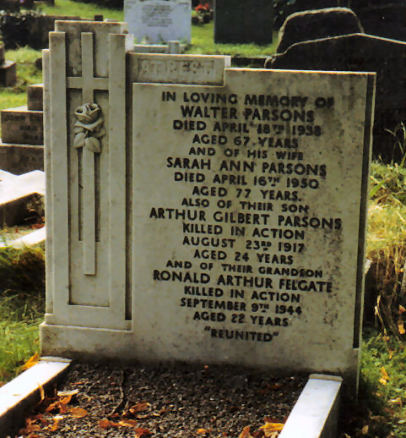 Corporal
5348817, 9th Bn., Royal Fusiliers (City of London Regt.). Son of
Reginald William John and Doris Felgate, of Wendover, Buckinghamshire.
Born Bucks. Residence Bucks. Died on Saturday 9th September 1944.
Age 22. Buried in GRADARA WAR CEMETERY, Italy I, E, 74. Also commemorated
on the family grave in Wendover Churchyard. Corporal
5348817, 9th Bn., Royal Fusiliers (City of London Regt.). Son of
Reginald William John and Doris Felgate, of Wendover, Buckinghamshire.
Born Bucks. Residence Bucks. Died on Saturday 9th September 1944.
Age 22. Buried in GRADARA WAR CEMETERY, Italy I, E, 74. Also commemorated
on the family grave in Wendover Churchyard. |
||
| GURNEY | Arthur W |
Able
Seaman P/J89805, H.M.S. Berwick., Royal Navy. Son of Arthur William and
Ellen Gurney, of Wendover, Buckinghamshire. Died on Sunday 7th March 1943.
Age 40. HMS Berwick (65) was a Royal Navy County Class Cruiser, of the
Kent subclass. From 1941 she was engaged in the Russian Convoys and North
Sea. Buried in REYKJAVIK (FOSSVOGUR) CEMETERY, Iceland. C40. 36. |
||
| GURNEY | Edward Thomas |
Serjeant
13077183, 237 Coy., Pioneer Corps. Son of William and Hellen Gurney; husband
of Phillis Maud Gurney, of Prestwood, Buckinghamshire. Born Bucks. Residence
Bucks. Died on Monday 21st May 1945. Age 33. Buried in TILBURG (GILZERBAAN)
GENERAL CEMETERY, Noord-Brabant, Netherlands. Plot B. Row 1. Grave 23. |
||
| HICKS | Peter Gamble |
Leading Seaman P/JX 325274, H.M.L.C.T.332., Royal Navy. Adopted son of Mrs. M. Hicks, of Wendover, Buckinghamshire. Killed in action on Saturday 28th August 1943. Age 20. No known grave. Commemorated on PORTSMOUTH NAVAL MEMORIAL, Hampshire, United Kingdom. Panel 73, Column 2.
|
||
| HICKS | Albert |
Corporal
539000, 2nd Bn. West Yorkshire Regt. (Prince of Wales's Own). Son of John
and Mary Hicks, of Wendover, Buckinghamshire; husband of Mary Josephine
Hicks, of Wendover. Died 23rd April 1944. Age 29. Buried in IMPHAL WAR
CEMETERY. 3. D. 10. |
||
| MILNER | P
|
Possibly
Peter MILNER, Flying Officer 123235, Royal Air Force Volunteer Reserve.
Died on Tuesday 7th March 1944. Age 21. Cremated and commemorated
in LEEDS (COTTINGLEY HALL) CREMATORIUM, Yorkshire, United Kingdom
Screen Wall |
||
| MATCHETT | Edward John |
Second
Engineer Officer, S.S. Fort La Montee (London), Merchant Navy. Son of
Edward and Ida Matchett; husband of Kate Matchett, of Wendover, Buckinghamshire.
Died on Saturday 7th August 1943. Age 44. SS Fort La Montee was carry
ammunition and a number of fires broke out on her in Algiers Harbour.
She blew up killing a number of her crew and over 100 crew from HMS Arrow,
which had come alongside to fight the fires. Buried in EL ALIA CEMETERY,
Algeria. 12. E. 24. |
||
| MITCHELL | Walter Herbert |
Sergeant
569064, 40 Sqdn., Royal Air Force. Son of John and Emily Mitchell; husband
of Dorothy Elizabeth Mitchell, of Wendover, Buckinghamshire. Died on Tuesday
28th July 1942. Age 21. The Sqn. Was operating Vickers Wellington III
from Sallufa, against targets in North Africa. No known grave. Commemorated
on ALAMEIN MEMORIAL, Egypt. Column 262. |
||
| MUSCHAMP | John Edward George |
Flying
Officer 153175 (Pilot), 218
Sqdn., Royal Air Force. Son of Group Captain George Allen Rodolphe
Muschamp, R.A.F., and Louise Henriette Helene, Muschamp, of Wendover Buckinghamshire.
Died on Thursday 22nd February 1945. Age 21. Sqdn. Flying Avro Lancasters
from Chedburgh joined from No 31 base Stradishall 15 February 1945. Buried
in REICHSWALD FOREST WAR CEMETERY, Kleve, Nordrhein-Westfalen, Germany.
17. B. 16. |
||
| NICHOLLS | Anthony Holbech |
Lieutenant,
H.M.S.
Sphinx, Royal Navy. Son of the Revd.Canon Reginald Morton Nicholls
M.A. and Phyllis Nicholls, of Wendover, Buckinghamshire. Died on Sunday
4th February 1940. Age 26. No known grave. Commemorated on CHATHAM NAVAL
MEMORIAL, Kent, United Kingdom. 34, 1. In January 1940 HMS Sphinx moved to Scottish waters and on 21st January 1940 she rushed to the aid of the destroyer HMS Exmouth which had been torpedoed 20 miles off Wick. There were no survivors. At about 0800 on 3rd February 1940, SPHINX, Speedwell and Skipjack commenced sweeping north of Kinnaird Head. At 0912 a bomb struck the SPHINX forward. It went through the back of the T.S. , through the front of the bridge, through the forecastle deck and burst on the Mess Deck. The explosion folded the forecastle back on to the bridge and badly crippled the whole fore end of the ship. The Captain (Taylor) was killed outright on the bridge. Attempts were made to tow the ship. At about 0430 on 4th February a large wave struck the ship forward and she immediately capsized. Five officers and forty nine ratings were killed. She was the first Halcyon to be lost. |
||
| ROBINSON | P
A |
Probably
ROBINSON, Philip Augustus, Captain 101261, Royal Army Medical Corps.
Son of Ernest Augustus and Mabel Henrietta Robinson, of Chaguanas,
Trinidad; husband of Kathleen Robinson, of Chaguanas. L.R.C.P.,
M.R.C.S. Born Barbados, residence Bucks. Died 10th November 1944.
Age 33. Buried in MIERLO WAR CEMETERY. II. E. 6. |
||
| SLADE | Colin W |
Corporal
5392806, 7th Bn., Argyll and Sutherland Highlanders. Born Bucks, residence
Bucks. Died on Saturday 28th April 1945. Age 22. Buried in BECKLINGEN
WAR CEMETERY, Soltau, Niedersachsen, Germany. 5. C. 2. |
||
| SIMMONS | Lancelot Thomas Francis |
Private
14430925, 4th Bn., Lincolnshire Regiment. Son of Harold Francis and Alfreda
Mary Simmons, of Wendover, Buckinghamshire. Born Bucks. Residence Bucks.
Died on Sunday 8th October 1944. Age 19. Buried in OISTERWIJK (ST. PETER)
ROMAN CATHOLIC CHURCHYARD, Noord-Brabant, Netherlands. Grave 10. |
||
| WARNER | Harold |
Petty
Officer Stoker P/K 56597 Royal Navy. Son of Archibald and Annie Warner;
husband of Annie Warner, of Bexley, New South Wales, Australia. Killed
in action 19 January 1940. Age 38. HMS Grenville, a G –Class destroyer
struck a mine in the North Sea. No known grave. Commemorated on PORTSMOUTH
NAVAL MEMORIAL Panel 41, Column 3. |
||
Last updated 12 November, 2019
 War Memorials Trust |
Main
page  Commonwealth War Graves Commission Copyright © Roll-of-Honour.com 2002- | GDPR Cookies Email: webmaster@roll-of-honour.com |

|


 Private
25676, 1st Battalion Grenadier Guards. Youngest son of Sir Thomas
and Lady Barlow of Boswells and London. Born in Bloomsbury and educated
at Marlborough and New College Oxford, awarded MA degree. Director
of Barlow and Jones, Cotton Spinners and Manufacturers, Bolton.
Age 32. Enlisted Bolton. Died in hospital at Rouen 18th January
1917 from blood poisoning contracted while suffering from trench
foot. Throughout December 1916 and January 1917 the battalion was
billeted in the area of Combles, Meulte and Bronfay Camp between
spells in the front-line around Bouleaux Wood. Buried in St. Sever
Cemetery Extension Rouen; Block 0, Plot 6, Row 0, Grave I
Private
25676, 1st Battalion Grenadier Guards. Youngest son of Sir Thomas
and Lady Barlow of Boswells and London. Born in Bloomsbury and educated
at Marlborough and New College Oxford, awarded MA degree. Director
of Barlow and Jones, Cotton Spinners and Manufacturers, Bolton.
Age 32. Enlisted Bolton. Died in hospital at Rouen 18th January
1917 from blood poisoning contracted while suffering from trench
foot. Throughout December 1916 and January 1917 the battalion was
billeted in the area of Combles, Meulte and Bronfay Camp between
spells in the front-line around Bouleaux Wood. Buried in St. Sever
Cemetery Extension Rouen; Block 0, Plot 6, Row 0, Grave I  Private
9975, 2nd Battalion Oxfordshire and Buckinghamshire Light Infantry.
Born Wendover. Enlisted Aylesbury 1914 Lived in Clay Lane. Killed
in action 13th November 1916 near Beaumont Hamel. On 13th November
1916 the battalion's objective was the Yellow Line (the German second
line). Leading elements of 5th Infantry Brigade captured the German
front line with little resistance. The battalion, coming up in support,
suffered some casualties from its own barrage and during heavy bombing
of Munich Trench. After crossing the Green Line the leading waves
appear to nave lost direction. They wheeled northwards in the mist
and fell into a communication trench, known as Lager Alley, running
east and west between the Green and Yellow Lines. This mistake was
discovered, and the Yellow Line was entered by disorganised elements
from, all companies. There was considerable fighting here, in Munich
Trench, and in Lager Alley. This resulted in the forward parties
being all but surrounded and a withdrawal, covered by bombers and
Lewis gunners, was carried out to the Green Line, which was consolidated.
The battalion lost one officer killed, two died of wounds, five
wounded and three missing. The casualties amongst the other ranks
were ten killed, one hundred and forty-nine wounded, and seventy-six
missing. The battalion was in action from 5.45 am on the 13th until
the night of the 15th/16th November. Originally buried in Redan
Ridge Cemetery Number 3, Beaumont Hamel. His grave was destroyed
by German shellfire in later fighting and he is now commemorated
on Special Memorial B7 in that cemetery.
Private
9975, 2nd Battalion Oxfordshire and Buckinghamshire Light Infantry.
Born Wendover. Enlisted Aylesbury 1914 Lived in Clay Lane. Killed
in action 13th November 1916 near Beaumont Hamel. On 13th November
1916 the battalion's objective was the Yellow Line (the German second
line). Leading elements of 5th Infantry Brigade captured the German
front line with little resistance. The battalion, coming up in support,
suffered some casualties from its own barrage and during heavy bombing
of Munich Trench. After crossing the Green Line the leading waves
appear to nave lost direction. They wheeled northwards in the mist
and fell into a communication trench, known as Lager Alley, running
east and west between the Green and Yellow Lines. This mistake was
discovered, and the Yellow Line was entered by disorganised elements
from, all companies. There was considerable fighting here, in Munich
Trench, and in Lager Alley. This resulted in the forward parties
being all but surrounded and a withdrawal, covered by bombers and
Lewis gunners, was carried out to the Green Line, which was consolidated.
The battalion lost one officer killed, two died of wounds, five
wounded and three missing. The casualties amongst the other ranks
were ten killed, one hundred and forty-nine wounded, and seventy-six
missing. The battalion was in action from 5.45 am on the 13th until
the night of the 15th/16th November. Originally buried in Redan
Ridge Cemetery Number 3, Beaumont Hamel. His grave was destroyed
by German shellfire in later fighting and he is now commemorated
on Special Memorial B7 in that cemetery.
 Private
26400 5th Battalion. Oxfordshire and Buckinghamshire Light Infantry.
(Also
served as Private 7649 2nd Battalion Oxfordshire and Buckinghamshire
Light Infantry and as Private 26400 6th Battalion Oxfordshire and
Buckinghamshire Light Infantry). Son
of Mrs Harriet Birch of 4 Tring Road. Age 28. Born
in Ellesborough. Enlisted
at Oxford in 1914. Killed
in action 23rd March 1918 near Flavy. At 6.05am on 2Ist March the
battalion moved into the Battle Zone to meet the German attack.
They reached the Zone at II. 30am, having suffered heavy casualties
from shellfire. They took up positions on the Benay-Essigny road,
in the old second line. At night this line was abandoned and all
troops retired behind the canal line at Flavy. At 5.30am on the
22nd the battalion moved up from Petit Detroit to hold the canal
bank. This line was lost early on the morning of the 23rd. B Company
sent up to reinforce near Flavy station was entirely overwhelmed.
At 11.30am. the battalion retired before the enemy, fighting all
the way to Riez de Cugny. An intense machine-gun barrage v/as put
down by the Germans. They finally dug-in in a strong point near
the village. Since the 2Ist the battalion had lost 18 officers and
about 350 other ranks killed, wounded and missing. A
report in “The Wendover Magazine” of October 1917 states
that Birch had just come through his 15th action safely. Commemorated
on the Pozieres Memorial; Panels 50-51. (Possibly buried in Annois
Communal Cemetery.)
Private
26400 5th Battalion. Oxfordshire and Buckinghamshire Light Infantry.
(Also
served as Private 7649 2nd Battalion Oxfordshire and Buckinghamshire
Light Infantry and as Private 26400 6th Battalion Oxfordshire and
Buckinghamshire Light Infantry). Son
of Mrs Harriet Birch of 4 Tring Road. Age 28. Born
in Ellesborough. Enlisted
at Oxford in 1914. Killed
in action 23rd March 1918 near Flavy. At 6.05am on 2Ist March the
battalion moved into the Battle Zone to meet the German attack.
They reached the Zone at II. 30am, having suffered heavy casualties
from shellfire. They took up positions on the Benay-Essigny road,
in the old second line. At night this line was abandoned and all
troops retired behind the canal line at Flavy. At 5.30am on the
22nd the battalion moved up from Petit Detroit to hold the canal
bank. This line was lost early on the morning of the 23rd. B Company
sent up to reinforce near Flavy station was entirely overwhelmed.
At 11.30am. the battalion retired before the enemy, fighting all
the way to Riez de Cugny. An intense machine-gun barrage v/as put
down by the Germans. They finally dug-in in a strong point near
the village. Since the 2Ist the battalion had lost 18 officers and
about 350 other ranks killed, wounded and missing. A
report in “The Wendover Magazine” of October 1917 states
that Birch had just come through his 15th action safely. Commemorated
on the Pozieres Memorial; Panels 50-51. (Possibly buried in Annois
Communal Cemetery.) Lance Corporal
2674-I3 2nd/4th Battalion Oxfordshire and Buckinghamshire Light
Infantry. (Also served as Private 20435 2nd/Ist Buckinghamshire
Battalion, Oxfordsnire and Buckinghamshire Light Infantry). Light
Infantry. Son of Thomas and Laura Bishop of 'West on Turville. .
Husband of Esther Bishop of Tring Road. Born at Weston Turville.
Worked as a gardener.Age 36. Enlisted at Aylesbury in 1916. Died
of wounds I5th April 1918 at Aire-sur-la-Lys. On 12th April the
battalion took and held positions on the Robecq-Calonne road and
at Bacquerolles Farm. At 7.30am, in thick fog, the enemy attacked
to the battalion's left, requiring them to form a defensive flank.
The troops on the left flank then withdrew and C Company had to
carry out a local counter-attack to drive the Germans from a group
of houses. On the 14th, at 6.30am, C Company drove the enemy from
& further group of houses. Subsequently, in the belief that
some houses were not being& held by the enemy, a battle patrol,
consisting of a platoon of A Company was pushed out. After a short
advance the patrol came under heavy rifle and machine-gun fire.
There was an exchange of fire and the patrol withdrew, covered by
Lewis-gun fire. The battalion lost one officer wounded, three other
ranks killed, twenty-two wounded and one missing. Buried
in Aire Communal Cemetery; Plot 4, Row F, Grave 10.
Lance Corporal
2674-I3 2nd/4th Battalion Oxfordshire and Buckinghamshire Light
Infantry. (Also served as Private 20435 2nd/Ist Buckinghamshire
Battalion, Oxfordsnire and Buckinghamshire Light Infantry). Light
Infantry. Son of Thomas and Laura Bishop of 'West on Turville. .
Husband of Esther Bishop of Tring Road. Born at Weston Turville.
Worked as a gardener.Age 36. Enlisted at Aylesbury in 1916. Died
of wounds I5th April 1918 at Aire-sur-la-Lys. On 12th April the
battalion took and held positions on the Robecq-Calonne road and
at Bacquerolles Farm. At 7.30am, in thick fog, the enemy attacked
to the battalion's left, requiring them to form a defensive flank.
The troops on the left flank then withdrew and C Company had to
carry out a local counter-attack to drive the Germans from a group
of houses. On the 14th, at 6.30am, C Company drove the enemy from
& further group of houses. Subsequently, in the belief that
some houses were not being& held by the enemy, a battle patrol,
consisting of a platoon of A Company was pushed out. After a short
advance the patrol came under heavy rifle and machine-gun fire.
There was an exchange of fire and the patrol withdrew, covered by
Lewis-gun fire. The battalion lost one officer wounded, three other
ranks killed, twenty-two wounded and one missing. Buried
in Aire Communal Cemetery; Plot 4, Row F, Grave 10. Private 265709 A Company, Ist/i4th Battalion Oxfordshire and Buckinghamshire
Light Infantry. (Also served as Private 2365 Ist/Ist Buckinghamshire
Battalion, Oxfordshire and Buckinghamshire Light Infantry.) Son
of Mary Ann Bonharn and the late Thomas Bonham of Aylesbury Road
. Age 21. Nicknamed Skier.Killed
in action 27th August 1917 near St. Julien. Enlisted at Aylesbury.
He went to France with the 1st Buckinghamshire Battalion, on 30
March 1915. Served with them in the Ploegsteert Wood area and in
front of Hebuterne. Commemorated on the Tyne Cot Memorial; Panels
96 to 98. “The Wendover Magazine” of August
1915 included the following:
Private 265709 A Company, Ist/i4th Battalion Oxfordshire and Buckinghamshire
Light Infantry. (Also served as Private 2365 Ist/Ist Buckinghamshire
Battalion, Oxfordshire and Buckinghamshire Light Infantry.) Son
of Mary Ann Bonharn and the late Thomas Bonham of Aylesbury Road
. Age 21. Nicknamed Skier.Killed
in action 27th August 1917 near St. Julien. Enlisted at Aylesbury.
He went to France with the 1st Buckinghamshire Battalion, on 30
March 1915. Served with them in the Ploegsteert Wood area and in
front of Hebuterne. Commemorated on the Tyne Cot Memorial; Panels
96 to 98. “The Wendover Magazine” of August
1915 included the following: He
fought with the battalion in the initial attacks on Pozieres in
the second half of July 1916. On the afternoon of the I4th August
the battalion was ordered to retake Skyline Trench, to the east
of Pozieres. It was decided that C Company would carry out a bombing,
attack, supported by a party from A Company supporting their right
flank. This operation was successful and C and D Companies occupied
Skyline Trench and Sixth Avenue. The battalion was then subjected
to heavy shell fire which destroyed the trenches and continued until
their relief on the evening of the I5th. On the I5th, while serving
in A Company, Bonham suffered a gunshot wound in the right leg.
He was evacuated to the 1st/2nd South Midland Field Ambulance, at
Warloy-Baillon, and went from there to Number 3 Canadian Stationary
Hospital, at Rouen, before going to England.
He
fought with the battalion in the initial attacks on Pozieres in
the second half of July 1916. On the afternoon of the I4th August
the battalion was ordered to retake Skyline Trench, to the east
of Pozieres. It was decided that C Company would carry out a bombing,
attack, supported by a party from A Company supporting their right
flank. This operation was successful and C and D Companies occupied
Skyline Trench and Sixth Avenue. The battalion was then subjected
to heavy shell fire which destroyed the trenches and continued until
their relief on the evening of the I5th. On the I5th, while serving
in A Company, Bonham suffered a gunshot wound in the right leg.
He was evacuated to the 1st/2nd South Midland Field Ambulance, at
Warloy-Baillon, and went from there to Number 3 Canadian Stationary
Hospital, at Rouen, before going to England. Gunner
108061, D Battery, 11th Brigade, Royal .Field Artillery Son of Mr
and Mrs James Bowden of 6 Old Ford Cottages, Scrubwood. Age 23 Born
in Wendover. Enlisted at Aylesbury 4th September 1915. Carter. Killed
in action 24th September 1917 near Pilckem. D/11 Battery come into
the line on the 17th September. The batteries of the brigade were
distributed through the following map squares: C 1 a and c, C 7
a and b and 3 12 a and b, to the east-north-east of Pilckem. From
1.50am to 5am on the 24th the batteries, and Brigade HO at C I d
6 9, were subjected to heavy gas-shelling suffering one gunner killed.
Buried in Bluet Farm Cemetery; Plot I, Row F, Grave 51
Gunner
108061, D Battery, 11th Brigade, Royal .Field Artillery Son of Mr
and Mrs James Bowden of 6 Old Ford Cottages, Scrubwood. Age 23 Born
in Wendover. Enlisted at Aylesbury 4th September 1915. Carter. Killed
in action 24th September 1917 near Pilckem. D/11 Battery come into
the line on the 17th September. The batteries of the brigade were
distributed through the following map squares: C 1 a and c, C 7
a and b and 3 12 a and b, to the east-north-east of Pilckem. From
1.50am to 5am on the 24th the batteries, and Brigade HO at C I d
6 9, were subjected to heavy gas-shelling suffering one gunner killed.
Buried in Bluet Farm Cemetery; Plot I, Row F, Grave 51
 Private
3/8118 3rd Battalion Oxfordshire and Buckinghamshire Light Infantry,
attached 2nd Battalion. Only son of Mrs Pearce of Tring. Road. Born
in Tring. Enlisted at Oxford. Died
of wounds 10th October 1914 at La Cour de Soupir. Buried in Soupir
Churchyard; Row B, Grave 7.
Private
3/8118 3rd Battalion Oxfordshire and Buckinghamshire Light Infantry,
attached 2nd Battalion. Only son of Mrs Pearce of Tring. Road. Born
in Tring. Enlisted at Oxford. Died
of wounds 10th October 1914 at La Cour de Soupir. Buried in Soupir
Churchyard; Row B, Grave 7.
 1st Mate SS Bishopstone.
Son of Benjamin and the late Sarah Buckingham. Husband of Kate Buckingham,
nee Wyatt, of "Elthorpe", Nightingale Road. Born in Great
Kirnble. Age 41. Killed
by enemy action 4th September 1917 in the English Channel.. The
B'ishopstone was a vessel of 2,513 tons, owned by Swansea Steamers
Ltd. It was registered for home trade and was plying a regular cargo
run from Portsmouth to I.e Havre. On the 4th September she was sunk
by a submarine in the English Channel, while on passage from Le
Havre (50º8’ N, 0º57’ W). Commemorated on the Mercantile
Marine Memorial, Tower Hill; Panel 3.
1st Mate SS Bishopstone.
Son of Benjamin and the late Sarah Buckingham. Husband of Kate Buckingham,
nee Wyatt, of "Elthorpe", Nightingale Road. Born in Great
Kirnble. Age 41. Killed
by enemy action 4th September 1917 in the English Channel.. The
B'ishopstone was a vessel of 2,513 tons, owned by Swansea Steamers
Ltd. It was registered for home trade and was plying a regular cargo
run from Portsmouth to I.e Havre. On the 4th September she was sunk
by a submarine in the English Channel, while on passage from Le
Havre (50º8’ N, 0º57’ W). Commemorated on the Mercantile
Marine Memorial, Tower Hill; Panel 3.  Lieutenant-Colonel
1lth Battalion Queens Royal West Surrey Regiment (Also served as
Major with I5th Battalion Durham Light Infantry. )
Lieutenant-Colonel
1lth Battalion Queens Royal West Surrey Regiment (Also served as
Major with I5th Battalion Durham Light Infantry. ) Private 16320
1st Battalion Hampshire Regiment (Also served as Private 13495 9th
Battalion Oxfordshire and Buckinghamshire Light Infantry.) Born
in Wendover. Lived in Back Street. Enlisted at Oxford in 1914- Went
to France 2nd June 1915. Killed in action 1st July 1916 near Beaumont
Hamel. Commemorated on the Thiepval Memorial; Pier 7, Face C.
Private 16320
1st Battalion Hampshire Regiment (Also served as Private 13495 9th
Battalion Oxfordshire and Buckinghamshire Light Infantry.) Born
in Wendover. Lived in Back Street. Enlisted at Oxford in 1914- Went
to France 2nd June 1915. Killed in action 1st July 1916 near Beaumont
Hamel. Commemorated on the Thiepval Memorial; Pier 7, Face C.
 Shoeing Smith
Corporal 205163 1st/1st Royal Bucks. Hussars, also served as 935.
Son of Thomas and Elizabeth Carter of High Street. Brother of Thomas.
Born in Wendover. Enlisted at Aylesbury in 1913. Served with the
Regiment at Gallipoli from August to December 1915 when it returned
to Egypt following the evacuation.. Age 20. Died
of wounds 4th June 1917 at Kantara.
Shoeing Smith
Corporal 205163 1st/1st Royal Bucks. Hussars, also served as 935.
Son of Thomas and Elizabeth Carter of High Street. Brother of Thomas.
Born in Wendover. Enlisted at Aylesbury in 1913. Served with the
Regiment at Gallipoli from August to December 1915 when it returned
to Egypt following the evacuation.. Age 20. Died
of wounds 4th June 1917 at Kantara.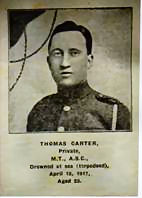 Private DM2/196369
895th MT Company, Army Service Corps. Son of Thomas and Elizabeth
Carter of High Street. Brother of Gordon Geoffrey. Born in Wendover.
Enlisted at Aylesbury.Died at sea 15th April 1917 in the Cyclades.
The 895th Mechanical Transport Company ASC (No 1 Mechanical Transport
Tractor Company) was formed at Deir-el-Belah, Egypt, on 13th April
19T7. On 15th April the SS Arcadian, a troopship of 6,939 tons sailing
from Alexandria to Salonika, was sunk by a submarine off the island
of Siphano in the Aegean. The ship was on the second leg of a voyage
to Marseille and bringing troops out from Britain. Two hundred and
seventy-one lives were lost in the sinking: 35 crew and 236 passengers.
Carter's body was recovered and his parents were told that he had
been buried in St George's cemetery on the island of Antiparos which
lies to the east of Siphano. The CWGC records that three special
memorials in Syra new British Cemetery bear the names of casualties
buried on Antiparos and Skarpanto whose graves had been washed away.
Commemorated on Special Memorial Grave'2 in Syra New British Cemetery.
Private DM2/196369
895th MT Company, Army Service Corps. Son of Thomas and Elizabeth
Carter of High Street. Brother of Gordon Geoffrey. Born in Wendover.
Enlisted at Aylesbury.Died at sea 15th April 1917 in the Cyclades.
The 895th Mechanical Transport Company ASC (No 1 Mechanical Transport
Tractor Company) was formed at Deir-el-Belah, Egypt, on 13th April
19T7. On 15th April the SS Arcadian, a troopship of 6,939 tons sailing
from Alexandria to Salonika, was sunk by a submarine off the island
of Siphano in the Aegean. The ship was on the second leg of a voyage
to Marseille and bringing troops out from Britain. Two hundred and
seventy-one lives were lost in the sinking: 35 crew and 236 passengers.
Carter's body was recovered and his parents were told that he had
been buried in St George's cemetery on the island of Antiparos which
lies to the east of Siphano. The CWGC records that three special
memorials in Syra new British Cemetery bear the names of casualties
buried on Antiparos and Skarpanto whose graves had been washed away.
Commemorated on Special Memorial Grave'2 in Syra New British Cemetery. Private G/7113
2nd Battalion Royal Fusiliers (Also served in 16th Battalion). Son
of Mr and Mrs James Deering of Chandos Street. Born in Wendover.
Enlisted at Mill Hill. Age 19. Died of wounds 1st August 1915 on
Malta. Landed at Gallipoli 16th June 1915. On the 23rd July 1915
the battalion sailed for the Gallipoli Peninsula, having been at
rest on Lemnos. They landed at Gully Beach on the 24th and went
into bivouacs. On the 26th they were bombed from the air, suffering
four men wounded. At 6pm on the 28th they took over the front line
of Essex Knoll and Worcester Flat. On the 29th they lost one man
Killed and four wounded. Buried in Pieta Military Cemetery, Malta;
Plot B, Row 4, Grave 1.
Private G/7113
2nd Battalion Royal Fusiliers (Also served in 16th Battalion). Son
of Mr and Mrs James Deering of Chandos Street. Born in Wendover.
Enlisted at Mill Hill. Age 19. Died of wounds 1st August 1915 on
Malta. Landed at Gallipoli 16th June 1915. On the 23rd July 1915
the battalion sailed for the Gallipoli Peninsula, having been at
rest on Lemnos. They landed at Gully Beach on the 24th and went
into bivouacs. On the 26th they were bombed from the air, suffering
four men wounded. At 6pm on the 28th they took over the front line
of Essex Knoll and Worcester Flat. On the 29th they lost one man
Killed and four wounded. Buried in Pieta Military Cemetery, Malta;
Plot B, Row 4, Grave 1.
 Private 19605
1st Battalion Wiltshire Regiment (Also served as Private 8112 3rd
Bn. attd. 2nd Bn. Oxfordshire and Buckinghamshire Light Infantry.)
Son of Walter and Sarah Deering of 1 Clay Lane, Born in Wendover.
Enlisted at Aylesbury. Age 21. Nicknamed Pednor. Killed
in action 6th Kay 1916 near La Targette.
Private 19605
1st Battalion Wiltshire Regiment (Also served as Private 8112 3rd
Bn. attd. 2nd Bn. Oxfordshire and Buckinghamshire Light Infantry.)
Son of Walter and Sarah Deering of 1 Clay Lane, Born in Wendover.
Enlisted at Aylesbury. Age 21. Nicknamed Pednor. Killed
in action 6th Kay 1916 near La Targette. Lance Corporal
266125 2nd/Ist Buckinghamshire Battalion, Oxfordshire and Buckinghamshire
Light Infantry. Son of William and Martha Dell of Wellwick Cottages
and, latterly, High Street Great Missenden. Enlisted at Aylesbury.
Age 21. Killed in action I9th July 1916 near Laventie.
Lance Corporal
266125 2nd/Ist Buckinghamshire Battalion, Oxfordshire and Buckinghamshire
Light Infantry. Son of William and Martha Dell of Wellwick Cottages
and, latterly, High Street Great Missenden. Enlisted at Aylesbury.
Age 21. Killed in action I9th July 1916 near Laventie. Private 220505
8th Battalion Royal Berkshire Regiment (Also served as Private 265710
Oxfordshire and Buckinghamshire Light Infantry, 2/1st Bucks Battalion.
Son of James and Sarah Dorrell of London Road. Enlisted at Aylesbury
in 191 if Nicknamed Kruger. Age 20. Died
of wounds 26th August 1918 at Daours.
Private 220505
8th Battalion Royal Berkshire Regiment (Also served as Private 265710
Oxfordshire and Buckinghamshire Light Infantry, 2/1st Bucks Battalion.
Son of James and Sarah Dorrell of London Road. Enlisted at Aylesbury
in 191 if Nicknamed Kruger. Age 20. Died
of wounds 26th August 1918 at Daours. A/2nd/Corporal
560602 Royal Engineers Signal Service X Corps HQ Signal Company,
serving in VII Corps area around Nurlu. Also served as Private (T)3971
Royal Engineers. Son of Alfred and Sarah Drake of York Buildings,
Tring Road. Born in Wendover, Lived at Hampstead. Enlisted Kilbuirn.
Husband of Annie Drake of Pimlico. Killed accidentally I6th January
1918 at Guyencourt-Saulcourt. Killed when the cellar in which he
was sleeping collapsed in on him. Buried in Saulcourt Churchyard
Extension; Row B, Grave 6.
A/2nd/Corporal
560602 Royal Engineers Signal Service X Corps HQ Signal Company,
serving in VII Corps area around Nurlu. Also served as Private (T)3971
Royal Engineers. Son of Alfred and Sarah Drake of York Buildings,
Tring Road. Born in Wendover, Lived at Hampstead. Enlisted Kilbuirn.
Husband of Annie Drake of Pimlico. Killed accidentally I6th January
1918 at Guyencourt-Saulcourt. Killed when the cellar in which he
was sleeping collapsed in on him. Buried in Saulcourt Churchyard
Extension; Row B, Grave 6. Private 48053
4th Battalion Worcestershire Regiment, also served 3rd Battalion
Son of James and Emma Edmonds. Husband of Eva Edmonds of Clay Lane.
Born Wendover. Enlisted Aylesbury. Worked in the King's Head Brewery.
Nicknamed Tubby . Age 39. Killed in action 9th October 1917 near
Schrieboom
Private 48053
4th Battalion Worcestershire Regiment, also served 3rd Battalion
Son of James and Emma Edmonds. Husband of Eva Edmonds of Clay Lane.
Born Wendover. Enlisted Aylesbury. Worked in the King's Head Brewery.
Nicknamed Tubby . Age 39. Killed in action 9th October 1917 near
Schrieboom
 Sapper 266804,
264th Railway Company Royal Engineers (Also served as Private 5878
2nd/5th Battalion Suffolk Regiment.) Son of Joseph and Elizabeth
Fantham of London Road. Husband of Isabella Fantham of Aylesbury.
Enlisted at Aylesbury in the autumn of 1916. Worked as a blacksmith.
Nicknamed Hoboy. Age 40. Uncle of William George Fantham. Died of
wounds 30th August 1917 at Boulogne. (39 General Hospital).
Sapper 266804,
264th Railway Company Royal Engineers (Also served as Private 5878
2nd/5th Battalion Suffolk Regiment.) Son of Joseph and Elizabeth
Fantham of London Road. Husband of Isabella Fantham of Aylesbury.
Enlisted at Aylesbury in the autumn of 1916. Worked as a blacksmith.
Nicknamed Hoboy. Age 40. Uncle of William George Fantham. Died of
wounds 30th August 1917 at Boulogne. (39 General Hospital).

 Private 2162
1st/5th Leicestershire Regiment Son of William and Jane Fantham
of The Pack Horse, Tring Road. Born in Wendover . Enlisted at Loughborough.
Age 22. Killed in action 8th May 1916 near Neuville St. Vaast. Landed
at Havre with battalion 28th February 1915.
Private 2162
1st/5th Leicestershire Regiment Son of William and Jane Fantham
of The Pack Horse, Tring Road. Born in Wendover . Enlisted at Loughborough.
Age 22. Killed in action 8th May 1916 near Neuville St. Vaast. Landed
at Havre with battalion 28th February 1915. At 1.45pm on
the 29th April the battalion paraded on the Duffin-Perin road and
took over the front line at Neuville St. Vaast using all four companies.
They remained in the line until 9pm on the 8th May, when they were
relieved by the King's Royal Rifle Corps. While not providing fatigue
parties the off duty troops rested in caves beneath Neuville St.
Vaast.
At 1.45pm on
the 29th April the battalion paraded on the Duffin-Perin road and
took over the front line at Neuville St. Vaast using all four companies.
They remained in the line until 9pm on the 8th May, when they were
relieved by the King's Royal Rifle Corps. While not providing fatigue
parties the off duty troops rested in caves beneath Neuville St.
Vaast. Private 8668 Q
Company, 1st Battalion Oxfordshire and Buckinghamshire Light Infantry.
Son of George Harding, widower, of Aylesbury Road. Brother of Sam
and Sid. Age 27. Died 20th June 1916 near Ras al 'Ain. Enlisted
at Oxford in January 1908 and went to India in February 1910. Arrived
in Mesopotamia with the battalion on the 27th November 1914. Served
with them through the advance to Ctesiphon and during the siege
of Kut. At the fall of Kut 385 other ranks went into captivity.
Q Company marched out 58 strong, under the command of Sergeant Ward
DCM. Although weakened by the siege, they were marched 500 miles
from- Samarrah to Aleppo, in conditions of great ~-brutality. On,
or about, the I9th June the survivors reached Ras al 'Ain. The Medical
Officer and the Regimental Sergeant Major both reported that he
had died on the last stage of the march to this town. The escort
refused to allow his body to be brought into the camp for burial.
No more than one hundred and five men of the battalion survived
captivity. Commemorated on the Basra Memorial; Panels 26 and 63.
Private 8668 Q
Company, 1st Battalion Oxfordshire and Buckinghamshire Light Infantry.
Son of George Harding, widower, of Aylesbury Road. Brother of Sam
and Sid. Age 27. Died 20th June 1916 near Ras al 'Ain. Enlisted
at Oxford in January 1908 and went to India in February 1910. Arrived
in Mesopotamia with the battalion on the 27th November 1914. Served
with them through the advance to Ctesiphon and during the siege
of Kut. At the fall of Kut 385 other ranks went into captivity.
Q Company marched out 58 strong, under the command of Sergeant Ward
DCM. Although weakened by the siege, they were marched 500 miles
from- Samarrah to Aleppo, in conditions of great ~-brutality. On,
or about, the I9th June the survivors reached Ras al 'Ain. The Medical
Officer and the Regimental Sergeant Major both reported that he
had died on the last stage of the march to this town. The escort
refused to allow his body to be brought into the camp for burial.
No more than one hundred and five men of the battalion survived
captivity. Commemorated on the Basra Memorial; Panels 26 and 63.

 Gunner 292628
48th Heavy Battery, Royal Garrison Artillery (Also served as Gunner
930 I35th Oxfordshire Heavy Battery, Royal Garrison Artillery (TF).)
Son of George Harding, widower, of Aylesbury Road. Brother of Edward
and Sid. Enlisted at Aylesbury. Age 30 Died
of wounds 29th November 1917 at 52 Field Ambulance, Canada Farm.
Gunner 292628
48th Heavy Battery, Royal Garrison Artillery (Also served as Gunner
930 I35th Oxfordshire Heavy Battery, Royal Garrison Artillery (TF).)
Son of George Harding, widower, of Aylesbury Road. Brother of Edward
and Sid. Enlisted at Aylesbury. Age 30 Died
of wounds 29th November 1917 at 52 Field Ambulance, Canada Farm.


 Private 25220
12th Battalion South Wales Borderers (Also served as Private 8145
Army Cyclist Corps.) Spent periods attached to 229 Company Royal
Engineers and the Machine Gun Corps. Son of George Harding, widower,
of Aylesbury Road. Brother of Edward and Sam. Enlisted at Northampton
in 191/f, where working as an engineering apprentice. Age 23. Killed
in action 1lth March 1917 near Clery-sur-Somme.
Private 25220
12th Battalion South Wales Borderers (Also served as Private 8145
Army Cyclist Corps.) Spent periods attached to 229 Company Royal
Engineers and the Machine Gun Corps. Son of George Harding, widower,
of Aylesbury Road. Brother of Edward and Sam. Enlisted at Northampton
in 191/f, where working as an engineering apprentice. Age 23. Killed
in action 1lth March 1917 near Clery-sur-Somme.
 Corporal I5027
7th Battalion Bedfordshire Regiment. Born in Wendover and lived
at Peacock Farm. Enlisted at Watford. Died of wounds 26th September
1916 at Contay.
Corporal I5027
7th Battalion Bedfordshire Regiment. Born in Wendover and lived
at Peacock Farm. Enlisted at Watford. Died of wounds 26th September
1916 at Contay. Private PO/1882
Royal Marine Light Infantry, 1st Royal Marine Battalion, 63rd Royal
Naval Division Husband of Annie Horwood of Beechwood Cottage. Born
24th February 1878. Age 40. Died
of wounds 5th July 1918 at Rouen. Buried in St Sever Cemetery Extenstion,
Rouen; Bock Q, Plot 2, Row E, Grave 24
Private PO/1882
Royal Marine Light Infantry, 1st Royal Marine Battalion, 63rd Royal
Naval Division Husband of Annie Horwood of Beechwood Cottage. Born
24th February 1878. Age 40. Died
of wounds 5th July 1918 at Rouen. Buried in St Sever Cemetery Extenstion,
Rouen; Bock Q, Plot 2, Row E, Grave 24
 Captain D Company,
6th Battalion Royal Berkshire Regiment Son of Rev Thomas William
and Alethea Mary Hudson, of the Vicarage Wendover. Age 25 Killed
in action 31 July 1917.
Captain D Company,
6th Battalion Royal Berkshire Regiment Son of Rev Thomas William
and Alethea Mary Hudson, of the Vicarage Wendover. Age 25 Killed
in action 31 July 1917.
 Gunner 49159
F Battery, XIV Brigade, Royal Horse Artillery. Born in Aylesbury.
Enlisted London 1914. Died
of wounds 16th September 1916 at Heilly.
Gunner 49159
F Battery, XIV Brigade, Royal Horse Artillery. Born in Aylesbury.
Enlisted London 1914. Died
of wounds 16th September 1916 at Heilly.


 Private 40887
2nd Battalion Suffolk Regiment (Also served as Private 31507 Suffolk
Regt.) Born in Wendover. Lived at the Wellhead Inn. Enlisted at
Pinner. Killed
in action I2th May 1917 near Monchy.
Private 40887
2nd Battalion Suffolk Regiment (Also served as Private 31507 Suffolk
Regt.) Born in Wendover. Lived at the Wellhead Inn. Enlisted at
Pinner. Killed
in action I2th May 1917 near Monchy.

 Lieutenant
2nd Battalion Royal Scots Fusiliers. Younger son of the late John
Kennedy JP DL and Mrs Kennedy of Bacombe Warren and Underwood, Ayrshire.
Age 26. Commissioned October 1906. Promoted Lieutenant September
1911. Mentioned in despatches for services in France and Belgium.
Killed in action 25th October 1914 near Beceleare.
Lieutenant
2nd Battalion Royal Scots Fusiliers. Younger son of the late John
Kennedy JP DL and Mrs Kennedy of Bacombe Warren and Underwood, Ayrshire.
Age 26. Commissioned October 1906. Promoted Lieutenant September
1911. Mentioned in despatches for services in France and Belgium.
Killed in action 25th October 1914 near Beceleare.
 Private SD/705
11th Battalion Royal Sussex Regiment. Son of Frederick Bailey and
Rosina Langford of Boddington.. Born in Watford. Enlisted at Horsham.
Age 21. Killed
in action 30th June 1916 near Rue du Bois.
Private SD/705
11th Battalion Royal Sussex Regiment. Son of Frederick Bailey and
Rosina Langford of Boddington.. Born in Watford. Enlisted at Horsham.
Age 21. Killed
in action 30th June 1916 near Rue du Bois. Second Lieutenant
2nd/9th Battalion London Regiment (Queen Victoria's Rifles). Son
of Mrs Marshall of Manor House. Husband of Alice Eva Winkfield (formerly
Marshall) of Clapham, London. Born in Marylebone 21st July 1880.
Age 37. Killed in action 26th September 191? near St. Julien. Commemorated
on the Tyne Cot Memorial, Addendum.
Second Lieutenant
2nd/9th Battalion London Regiment (Queen Victoria's Rifles). Son
of Mrs Marshall of Manor House. Husband of Alice Eva Winkfield (formerly
Marshall) of Clapham, London. Born in Marylebone 21st July 1880.
Age 37. Killed in action 26th September 191? near St. Julien. Commemorated
on the Tyne Cot Memorial, Addendum.
 Sergeant 49
8th Battalion Northumberland Fusiliers. Born in Ipswich. Enlisted
at Norwich. Died of wounds 25th August 1915 at Suvla Bay. Proceeded
overseas with Battalion July 1915.
Sergeant 49
8th Battalion Northumberland Fusiliers. Born in Ipswich. Enlisted
at Norwich. Died of wounds 25th August 1915 at Suvla Bay. Proceeded
overseas with Battalion July 1915.
 Private 41614
2nd Battalion Royal Inniskilling Fusiliers (Also served as Private
T4/142201 Army Service Corps.) Husband of L Parkins of 6 Scrubwood
Cottages. Brother-in-law of Archibald Bowden. Born in Scrubwood.
Enlisted at Aylesbury. Died of wounds (gas) 13th August 1917 at
Coxyde.
Private 41614
2nd Battalion Royal Inniskilling Fusiliers (Also served as Private
T4/142201 Army Service Corps.) Husband of L Parkins of 6 Scrubwood
Cottages. Brother-in-law of Archibald Bowden. Born in Scrubwood.
Enlisted at Aylesbury. Died of wounds (gas) 13th August 1917 at
Coxyde. Private 33595 12th
Battalion Gloucestershire Regiment. Also served 6th Battalion.Son
of Thomas Parkins. Husband of Florence Jane Parkins of Woodlands
Lodge, Great Missenden. Born in Ellesborough. Age 32. Enlisted at
Great Missenden. Killed in action 8th May 1917 near Fresnoy.
Private 33595 12th
Battalion Gloucestershire Regiment. Also served 6th Battalion.Son
of Thomas Parkins. Husband of Florence Jane Parkins of Woodlands
Lodge, Great Missenden. Born in Ellesborough. Age 32. Enlisted at
Great Missenden. Killed in action 8th May 1917 near Fresnoy.
 Private 22477
5th Battalion Oxfordshire and Buckinghamshire Light Infantry. (Also
served as Private 4442 1st/4th Battalion.) Son of Walter and Sarah
Ann Parsons of Pound Street. Enlisted at Aylesbury. Age 24 Killed
in action 23rd August 1917 near Glencorse 'Wood.
Private 22477
5th Battalion Oxfordshire and Buckinghamshire Light Infantry. (Also
served as Private 4442 1st/4th Battalion.) Son of Walter and Sarah
Ann Parsons of Pound Street. Enlisted at Aylesbury. Age 24 Killed
in action 23rd August 1917 near Glencorse 'Wood. Commemorated on
the Tyne Got Memorial; Panels 96 to 98. Also commemorated on the
family grave in Wendover churchyard with his nephew Ronald Arthur
Felgate, Corporal 5348817 9th Bn., Royal Fusiliers (City of London
Regt.)killed in action 9th September I944 aged 22. Gradara War Cemetery,
Italy I, E, 74
Commemorated on
the Tyne Got Memorial; Panels 96 to 98. Also commemorated on the
family grave in Wendover churchyard with his nephew Ronald Arthur
Felgate, Corporal 5348817 9th Bn., Royal Fusiliers (City of London
Regt.)killed in action 9th September I944 aged 22. Gradara War Cemetery,
Italy I, E, 74
 Private 12118
C Company, 2nd Battalion Duke of Cornwall's Light Infantry. (Also
served with the 3rd Battalion.) Son of Frederick John and Emily
Pedel of the Railway Hotel, Pound Street. Born Halton. Age 21 .
Enlisted at St. Pancras in August 1914. Killed in action 15th February
1915 near St. Eloi. Trained with the 3rd (Reserve) Battalion at
Falmouth. 'Went to France on the 26th January 1915.
Private 12118
C Company, 2nd Battalion Duke of Cornwall's Light Infantry. (Also
served with the 3rd Battalion.) Son of Frederick John and Emily
Pedel of the Railway Hotel, Pound Street. Born Halton. Age 21 .
Enlisted at St. Pancras in August 1914. Killed in action 15th February
1915 near St. Eloi. Trained with the 3rd (Reserve) Battalion at
Falmouth. 'Went to France on the 26th January 1915. Stoker Petty Officer
2o'3<430 HMS Queen Mary. Son of Joe and Elizabeth Rogers of Bacombe
Terrace. Born the 25th of July 1873. Husband of Rosa Rogers of 7
St. Margaret's Terrace, Haslemere Road, Southsea. Age 43. Killed
in action 3Ist May 1916 off Jutland. Enlisted,
in 1893.
Stoker Petty Officer
2o'3<430 HMS Queen Mary. Son of Joe and Elizabeth Rogers of Bacombe
Terrace. Born the 25th of July 1873. Husband of Rosa Rogers of 7
St. Margaret's Terrace, Haslemere Road, Southsea. Age 43. Killed
in action 3Ist May 1916 off Jutland. Enlisted,
in 1893. Private 30121
2nd Battalion Royal Welsh Fusiliers. Son of Charles anadAnn Rowland
of Wyvenho, Perry Street. Born in Hammersmith, the family moving
to Wendover in 1909. Enlisted at 'Wandsworth. Age 27. Died of wounds
5th November 1916 near Lesbeoufs.
Private 30121
2nd Battalion Royal Welsh Fusiliers. Son of Charles anadAnn Rowland
of Wyvenho, Perry Street. Born in Hammersmith, the family moving
to Wendover in 1909. Enlisted at 'Wandsworth. Age 27. Died of wounds
5th November 1916 near Lesbeoufs.
 Lieutenant
3rd Battalion Royal Sussex Regiment, attached 2nd Battalion. Son
of Dr. and Mrs. Lauriston, Shaw of Icknield Cottage, Pound Street.
Age 22. Killed in action 9th May 1915 near Richebourg L'Avoue.
Lieutenant
3rd Battalion Royal Sussex Regiment, attached 2nd Battalion. Son
of Dr. and Mrs. Lauriston, Shaw of Icknield Cottage, Pound Street.
Age 22. Killed in action 9th May 1915 near Richebourg L'Avoue.
 Private BS3079
16th (Public Schools) Battalion Middlesex Regiment. Son of William
and Fanny Simmons of Pear Tree Cottage, High Street, Born in Wendover.
Nicked Gooseberry. Died of wounds 2nd July 1916 near Auchonvillers.
Enlisted
at Tring in 1914 in the Oxfordshire and Buckinghamshire Light Infantry.
Private BS3079
16th (Public Schools) Battalion Middlesex Regiment. Son of William
and Fanny Simmons of Pear Tree Cottage, High Street, Born in Wendover.
Nicked Gooseberry. Died of wounds 2nd July 1916 near Auchonvillers.
Enlisted
at Tring in 1914 in the Oxfordshire and Buckinghamshire Light Infantry. The Wendover
Magazine of August 1916 reported the following:
The Wendover
Magazine of August 1916 reported the following: Private (Acting
Lance-Corporal) 27251 2nd/4th Battalion Oxfordshire and Buckinghamshire
Light Infantry. Born in Wendover. Lived in Tring Road. Enlisted
at Aylesbury. The Commonwealth War Graves Commission and Soldiers
Died erroneously record his name as Summons. Killed
in action 23rd Larch near Prernont
Private (Acting
Lance-Corporal) 27251 2nd/4th Battalion Oxfordshire and Buckinghamshire
Light Infantry. Born in Wendover. Lived in Tring Road. Enlisted
at Aylesbury. The Commonwealth War Graves Commission and Soldiers
Died erroneously record his name as Summons. Killed
in action 23rd Larch near Prernont Private 5816
1st/4th Battalion Oxfordshire and Buckinghamshire Light Infantry.
Son of Mrs Sarah Simmons, widow, of Tring Road. Born in Buckingham.
Age 38. Died of wounds 16th August 1916 at Warloy Baillon. Enlisted
at Aylesbury late in 1915. Went to France in July 1916.
Private 5816
1st/4th Battalion Oxfordshire and Buckinghamshire Light Infantry.
Son of Mrs Sarah Simmons, widow, of Tring Road. Born in Buckingham.
Age 38. Died of wounds 16th August 1916 at Warloy Baillon. Enlisted
at Aylesbury late in 1915. Went to France in July 1916.
 Private 203641
6th Battalion Oxfordshire and Buckinghamshire Light Infantry. Son
of George and Ellen Slade of Cold Comfort. Age 19. Nicknamed Dapper.
Died of wounds 22nd September 1917 at Canada Farm. Enlisted at Aylesbury
and served with the 3rd/1st Bucks Battalion.
Private 203641
6th Battalion Oxfordshire and Buckinghamshire Light Infantry. Son
of George and Ellen Slade of Cold Comfort. Age 19. Nicknamed Dapper.
Died of wounds 22nd September 1917 at Canada Farm. Enlisted at Aylesbury
and served with the 3rd/1st Bucks Battalion.
 Private 41681
8th Battalion Leicestershire Regiment (Also served as Private 32313
Worcestershire -Regiment.) (Medal Rolls record previous service
with 1/1st Herts. Regt.) Son of William and Lucy Smith. Husband
of the late Lucy Smith of 7 Sidney Terrace. Born in Wendover. Enlisted
at Aylesbury. Age 39 Died 17th October 1918 near Givet. Died
while a prisoner of war in German hands. Originally buried in Givet
German Cemetery but the exact location of the grave could not be
established. Now commemorated on Givet German Cemetery Memorial
in Sedan Torcy French National Cemetery.
Private 41681
8th Battalion Leicestershire Regiment (Also served as Private 32313
Worcestershire -Regiment.) (Medal Rolls record previous service
with 1/1st Herts. Regt.) Son of William and Lucy Smith. Husband
of the late Lucy Smith of 7 Sidney Terrace. Born in Wendover. Enlisted
at Aylesbury. Age 39 Died 17th October 1918 near Givet. Died
while a prisoner of war in German hands. Originally buried in Givet
German Cemetery but the exact location of the grave could not be
established. Now commemorated on Givet German Cemetery Memorial
in Sedan Torcy French National Cemetery.
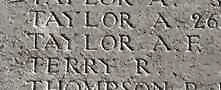 Private 203811
2nd/4th Battalion Oxfordshire and Buckinghamshire Light Infantry.
Husband of Mary Taylor of Cold Harbour. Enlisted at Aylesbury. Killed
in action 22nd August 1917 near St. Julien.
Private 203811
2nd/4th Battalion Oxfordshire and Buckinghamshire Light Infantry.
Husband of Mary Taylor of Cold Harbour. Enlisted at Aylesbury. Killed
in action 22nd August 1917 near St. Julien.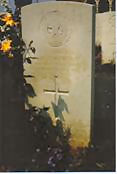 Corporal 513229
1st/14th Battalion London Regiment (London Scottish). (Also served
as 7250) Son of the late Mr. and Mrs. James Thompson. Lived at Dalston
near Carlisle. Age 38. Enlisted at Hackney. Killed in action 3Ist
August 1918 near Bullecourt. Proceeded
to France 15th July 1916
Corporal 513229
1st/14th Battalion London Regiment (London Scottish). (Also served
as 7250) Son of the late Mr. and Mrs. James Thompson. Lived at Dalston
near Carlisle. Age 38. Enlisted at Hackney. Killed in action 3Ist
August 1918 near Bullecourt. Proceeded
to France 15th July 1916 Private 265522
2nd/4th Battalion Oxfordshire and Buckinghamshire Light Infantry.
Son of 'Mr. and Mrs. George To ml in of Addington Cottages. Enlisted
at Aylesbury 21st August 1914. Age 22. Died
of wounds 13th September 1918 at Aire.
Private 265522
2nd/4th Battalion Oxfordshire and Buckinghamshire Light Infantry.
Son of 'Mr. and Mrs. George To ml in of Addington Cottages. Enlisted
at Aylesbury 21st August 1914. Age 22. Died
of wounds 13th September 1918 at Aire.
 Sergeant 3/6246
7th. Battalion Duke of Cornwall's Light Infantry. Born in Southwark.
Killed in action 1th April 1916 near Pilckem. Enlisted in the Regiment
on the 30th of January 1896 from the 4th (Militia) Battalion East
Surrey Regiment. Served in India from the 1st of December 1897 until
the 21st of December 1900, when he went to Ceylon, where he stayed
until the 30th of June 1901. He then returned home, before going
on the reserve after seven years' service. He left the reserve at
the end of January 1912. During this period he served as Private
A/4939. He held the India General Service Medal with two clasps;
Punjab frontier 1897-98 and Tirah 1897-98. He re-enlisted in the
Regiment in September 1914 at Oxford.
Sergeant 3/6246
7th. Battalion Duke of Cornwall's Light Infantry. Born in Southwark.
Killed in action 1th April 1916 near Pilckem. Enlisted in the Regiment
on the 30th of January 1896 from the 4th (Militia) Battalion East
Surrey Regiment. Served in India from the 1st of December 1897 until
the 21st of December 1900, when he went to Ceylon, where he stayed
until the 30th of June 1901. He then returned home, before going
on the reserve after seven years' service. He left the reserve at
the end of January 1912. During this period he served as Private
A/4939. He held the India General Service Medal with two clasps;
Punjab frontier 1897-98 and Tirah 1897-98. He re-enlisted in the
Regiment in September 1914 at Oxford. Private 2771 1st/1st
Buckinghamshire Battalion, Oxfordshire and Buckinghamshire Light
Infantry. Born in Bridgevvater. Enlisted at Aylesbury. Killed in
action 21st July 1916 near Pozieres. Went
to France on the 6th of May 1916, joining C Company on the 29th.
Private 2771 1st/1st
Buckinghamshire Battalion, Oxfordshire and Buckinghamshire Light
Infantry. Born in Bridgevvater. Enlisted at Aylesbury. Killed in
action 21st July 1916 near Pozieres. Went
to France on the 6th of May 1916, joining C Company on the 29th. Private 9212 R
Company, 1st Battalion Oxfordshire and Buckinghamshire Light Infantry.
Born in Wendover. Enlisted at High Wycornbe. Died 2bth July 1915
at Amarah.
Private 9212 R
Company, 1st Battalion Oxfordshire and Buckinghamshire Light Infantry.
Born in Wendover. Enlisted at High Wycornbe. Died 2bth July 1915
at Amarah.
 Guardsman 17352
2nd Battalion Grenadier Guards. Born in Wendover. Enlisted at Willesden.
Killed
in action 18th March 1916 near Potijze.
Guardsman 17352
2nd Battalion Grenadier Guards. Born in Wendover. Enlisted at Willesden.
Killed
in action 18th March 1916 near Potijze. Private 30641 1st
Battalion Worcestershire Regiment. Born in Wendover. Lived in Kensington.
Enlisted at Stroud. Killed in action 4th March 1917 near Bouchavesnes.
Private 30641 1st
Battalion Worcestershire Regiment. Born in Wendover. Lived in Kensington.
Enlisted at Stroud. Killed in action 4th March 1917 near Bouchavesnes. Private 266138
2nd/1st Buckinghamshire Battalion, Oxfordshire and Buckinghamshire
Light Infantry. Son of Herbert and Emily Edith Food of Mill Cottage,
Aylesbury Road. Enlisted at Aylesbury. Age 18. Killed in action
I9th July 1916 near Laventie. For
an account of the action in which he was killed see the entry for
Cecil Dell. Commemorated on the Loos Memorial; Panels 83 to 85.
Private 266138
2nd/1st Buckinghamshire Battalion, Oxfordshire and Buckinghamshire
Light Infantry. Son of Herbert and Emily Edith Food of Mill Cottage,
Aylesbury Road. Enlisted at Aylesbury. Age 18. Killed in action
I9th July 1916 near Laventie. For
an account of the action in which he was killed see the entry for
Cecil Dell. Commemorated on the Loos Memorial; Panels 83 to 85.

 Private 4443
1st/1st Buckinghamshire Battalion, Oxfordshire and Buckinghamshire
Light Infantry. Elder son of George Woodward of Aylesbury Road.
Born in Peckham. Enlisted at Aylesbury. Age 18. Killed in action
2Ist July 1916 near Pozieres. Went to France on the 6th of May 1916,
joining A Company on the 29th. For an account of the action in which
he was killed, see the entry for Charles Warner. Commemorated on
the Thiepval Memorial; Pier 10, Faces A and D.
Private 4443
1st/1st Buckinghamshire Battalion, Oxfordshire and Buckinghamshire
Light Infantry. Elder son of George Woodward of Aylesbury Road.
Born in Peckham. Enlisted at Aylesbury. Age 18. Killed in action
2Ist July 1916 near Pozieres. Went to France on the 6th of May 1916,
joining A Company on the 29th. For an account of the action in which
he was killed, see the entry for Charles Warner. Commemorated on
the Thiepval Memorial; Pier 10, Faces A and D.
