Throughout
Essex there are various memorials and
rolls of honour dedicated to those men and women who fell
in various wars. These memorials and rolls cover many centuries
in some cases, most World War One and Two.
During
any conflict there are certain acts of bravery or defiance
that are noticeable above others. For these acts citations
and medals have been awarded.
If
anybody has information for those of the Second World War,
Boer War, or the like similar to those supplied for the First
World War then I would gladly post these as well.
***
STOP PRESS ***
On
May 10/11, 1915, Zeppelin LZ38, commanded by Hauptmann
Erich Linnarz, dropped an incendiary bomb at 02.45 hours
near the prison ship Royal Edward moored just off Southend.
It then proceeded to bomb Southend.
The
children and teachers at Quince Tree Day Nursery in
South Ockendon, Essex made their own memorial which
was put up outside the nursery to commemorate their
heroes and remember VE Day 80 years ago.
Our
respect to those involved.
These
pages are available for transcripts of these memorials
and rolls of honour. If you have a transcription of,
or you are willing to transcribe, an Essex memorial
or roll of honour for these pages then please contact
me, the email address is below.
Current
acknowledgements for assistance with these pages must
go to Andy Pay and many others - thank you all.
Thank
you, Martin
Edwards
email:webmaster@roll-of-honour.com
Please
Note: Every attempt has been made to transcribe this information
accurately but there are occasions that the information supplied
is incorrect or errors occur during transcription. We do not
wish to cause offence to any families of the men detailed
here and will change the relevant information when informed.
Also
note that places detailed on these memorials may appear in
the wrong county. This information has been transcribed from
the records given and, as the men were parochial, the information
supplied at enlistment was the view of the men and the county
they thought they resided in.
DONATIONS
This
site is maintained solely by volunteers and is funded by them as private
individuals. This includes the purchase of photographs, books, rolls of
honour plus the running costs of the site. We have always intended to
make this site free to all. If you have gained from this site then please
consider making a donation through PayPal by clicking on the donation
button. Thank you.
If
you would like to donate but not on-line then cheques can be made payable
to, and sent to:
Martin
Edwards
88 Laurel Walk
Kempston
Bedford
MK42 7NT
World
War 1, 'C' Company, 5th Battalion, Essex Regiment.
World
War 1 & 2 - Others Selection
Pre-1914
- Memorial Selection
To
gain an overview of all the towns and parishes covered, and
hopefully to be covered, by this site there is an alphabetical
index.
For
further reading when researching World War 1 relatives then
there is a book published by the Federation of Family History
Societies for family Historians entitled "World War
I Army Ancestry - Third Edition" by Norman Holding ISBN
1 86006 056 2.
The
Essex Regiment can be researched at Chelmsford and Essex Museum,
Essex
Regiment Museum, Oaklands Park, Moulsham Street, Chelmsford
CM2 9AQ. Telephone (01245) 353066/260614. The Museum has a
surname database of Servicemen and women from the County of
Essex which may prove useful and many sources can be viewed.
Collections include archives, of 44th and 56th Regiments,
The Essex Regt and other units raised in Essex including The
Salamanca Eagle, captured from the French 62nd Regiment.
The
site commemorates the officers and support staff who have
been killed on duty whilst serving in Essex Police or any
of the predecessor forces to Essex Police. The site also
commemorates those officers who lost their lives during
the two World Wars.
Much
information about soldiers who fell, were awarded medals and more
is to be found in old copies of the London
Gazette. Here is a brief resume:
The
London Gazette, first published in 1665, is the oldest, continuously
published newspaper in the United Kingdom and probably the world.
The London Gazette and its sister publications, the Edinburgh
and Belfast Gazettes, have a unique position in British publishing.
They are official newspapers of the Crown. The London Gazette
contains a wide range of office notices including State, Parliamentary
and Ecclesiastical notices, Transport and Planning notices as
well as Corporate and Personal Insolvency notices to name a few.
In addition, a number of Supplements are published covering Honours
and Awards, Premium Bonds, Armed Forces Promotions and Re-gradings,
Companies' information, etc. and a Quarterly Index.
In
the 17th century, it was believed that National efficiency depended
on the intelligence received by the Crown and that the reckless
publishing of news might endanger it. An embargo on the printing
of news other than reports of events abroad, natural disasters,
Royal declarations and sensational crime continued until 1640.
This had the effect of delaying the development of the press in
the UK. Censorship was introduced in 1643, followed by licensing
of news publications. The Gazette came about because of two momentous
events: the Great Plague and the decision of King Charles II to
remove his court - effectively the government of the time - to
Oxford. The London Gazette started life as the Oxford Gazette
and after a few months changed to its current title.
NEWS
AND REVIEWS
This
section contains various news reports and cuttings, old and new,
with reference to the memorials in and around Huntingdonshire.
To view the section please click
here.
Friends
of War Memorials is a charity dedicated to promoting
awareness of the debt we owe to those who gave their
lives in the cause of freedom, by ensuring that their
memorials are properly maintained and preserved.
Some
of the cap badges are
laid out, on a separate page.
Not
all memorials were to people; there are memorials to various types
of animal that served and fell in World War I for example, dogs.
The
various memorials
and cemeteries maintained by the War Graves Commission for
the Western Front are described and pictured on the Internet.
Details of Kranji War Cemetery and Taiping can be found in the
Overseas section.
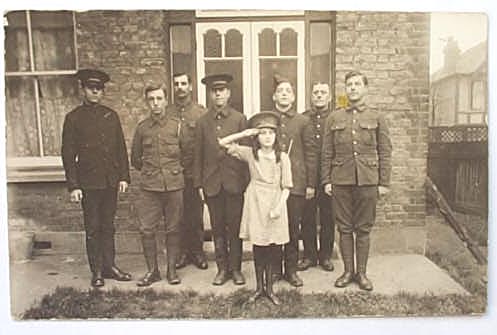
Soldiers
Billetted at Southend-on-Sea during World War 1




 The
children and teachers at Quince Tree Day Nursery in
South Ockendon, Essex made their own memorial which
was put up outside the nursery to commemorate their
heroes and remember VE Day 80 years ago.
The
children and teachers at Quince Tree Day Nursery in
South Ockendon, Essex made their own memorial which
was put up outside the nursery to commemorate their
heroes and remember VE Day 80 years ago. 


 The
Essex Regiment can be researched at Chelmsford and Essex Museum,
The
Essex Regiment can be researched at Chelmsford and Essex Museum,